HK Oil Stocks 2026: Dividend & Growth Comparison

[2026 Oil Stocks Investment Guide] Comprehensive Comparison of Hong Kong’s “Three Major Oil Companies”: Which Has the Highest Dividend Yield and the Most Potential?
Against the backdrop of continued volatility in global energy prices and persistent inflationary pressure, many investors seeking stable returns have turned their attention to defensive and high-dividend oil stocks in the Hong Kong market. Among them, the so-called “Three Major Oil Companies” are the main focus. However, for many investors, the differences between PetroChina, Sinopec, and CNOOC are often unclear. Which offers the highest dividend yield? Which has the greatest potential? These questions can be confusing. This article provides an in-depth analysis of the business models, financial conditions, and investment value of Hong Kong’s three major oil giants, along with a clear stock selection strategy to help you position your oil-related investment portfolio with confidence in a complex market.
Understanding Hong Kong’s Core Oil Stocks: What Are the “Three Major Oil Companies”?
The “Three Major Oil Companies” refers to China’s three largest state-owned oil and gas enterprises. They are not only the backbone of China’s energy security, but also major blue-chip stocks in the Hong Kong market. With their large market capitalizations and stable dividend policies, they attract many long-term investors. Understanding their respective positioning is the first step toward making informed oil stock investment decisions.
Introduction to the “Three Major Oil Companies”: PetroChina (0857.HK), Sinopec (0386.HK), and CNOOC (0883.HK)
- PetroChina Company Limited (“PetroChina”, 0857.HK): One of China’s largest oil and gas producers and distributors, covering the full industry chain from upstream exploration to downstream sales, making it the most comprehensive integrated energy giant.
- China Petroleum & Chemical Corporation (“Sinopec”, 0386.HK): The world’s largest refining company and third-largest chemical company, with a business focus on midstream and downstream operations such as refining, chemical production, and sales, as well as an extensive fuel station network.
- CNOOC Limited (“CNOOC”, 0883.HK): China’s largest offshore oil and gas producer, focusing on upstream exploration, development, and production, making it the most purely upstream company among the three.
Different Business Models: Upstream, Midstream, and Downstream Analysis
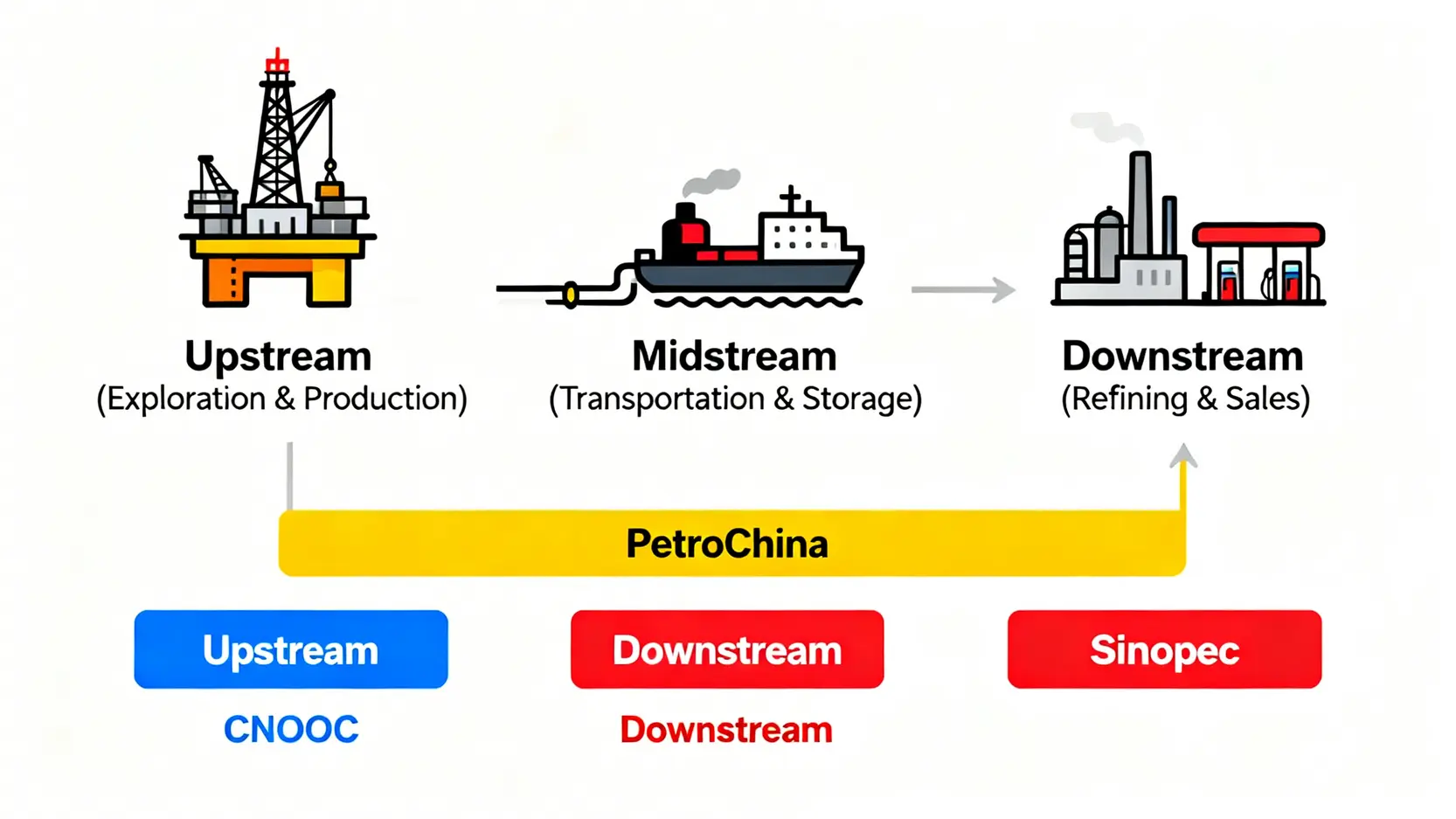
To understand the investment value of the “Three Major Oil Companies”, it is essential to understand their positions in the oil industry chain, as this directly determines their profit models and sensitivity to global oil prices.
- Upstream: Involves exploration, extraction, and production of oil and gas. Profits are directly linked to oil prices, with higher prices leading to higher profits. CNOOC is a typical upstream player.
- Midstream: Covers storage and transportation of oil and gas (such as pipelines and tankers). This segment is relatively stable, with income similar to “toll fees”. PetroChina has a strong presence in this area.
- Downstream: Involves refining crude oil into gasoline, diesel, and chemical products, and selling them to end consumers. Profit depends on refining margins (Refined Oil Price – Crude Oil Cost). Sinopec excels in downstream operations.

Positioning of the “Three Major Oil Companies” in the Industry Chain
In simple terms, their business focus can be summarized as follows:
- CNOOC (0883.HK): A pure upstream company that directly benefits from rising oil prices.
- PetroChina (0857.HK): The most integrated company, covering upstream, midstream, and downstream, with relatively balanced performance.
- Sinopec (0386.HK): Focused on midstream and downstream operations, benefiting more when oil prices are low or stable due to improved refining margins.
Further Reading (Highly Recommended)
[2026 US Dividend Stock Picks] 10 High-Yield Stocks Portfolio, Dividend Dates, and More
How to Buy Apple Stock? A Beginner’s 5-Step Guide From Currency Exchange to Placing Orders for AAPL
The Value of Investing in Oil Stocks: Why They Are High-Dividend Choices
In an environment of global economic uncertainty, investing in oil stocks, especially large state-owned enterprises like the “Three Major Oil Companies”, offers unique appeal. They not only act as stabilizers in the energy market, but also serve as reliable sources of cash flow in an investment portfolio.
Advantages: Stable Cash Flow, High Dividend Policies, and Inflation Hedging
- Stable cash flow: As essential commodities, oil and related products have relatively stable demand, providing consistent and substantial cash flow that supports generous dividends.
- Attractive dividend policies: To reward shareholders, the “Three Major Oil Companies” generally adopt high dividend payout policies. In strong oil market conditions, dividend yields can exceed 7%, far higher than many traditional income-generating instruments, making them highly attractive to investors seeking passive income. For more high-dividend stock strategies, refer to the further reading section.
- Natural inflation hedge: During periods of inflation, commodity prices tend to rise, and as oil is the “lifeblood of industry”, rising oil prices can directly boost the profitability of oil companies. Therefore, investing in oil stocks is regarded as an effective way to hedge against inflation.
Potential Risks: Oil Price Volatility, Geopolitical Impact, and Energy Transition Challenges
However, investing in oil stocks is not without risks. Before committing capital, it is essential to clearly understand the potential challenges:
- Oil price volatility: The share prices of oil companies are highly correlated with international oil price movements. Oil prices are influenced by global economic growth, supply and demand dynamics, US dollar exchange rates, and decisions by oil-producing organizations such as OPEC+, resulting in significant volatility.
- Geopolitical impact: Political instability in major oil-producing regions (such as the Middle East), or trade tensions between major consuming countries, can trigger sharp fluctuations in oil prices, thereby affecting oil companies’ earnings expectations and share price performance.
- Energy transition challenges: As global attention on climate change increases, “carbon neutrality” has become a long-term trend. Traditional fossil fuels face pressure from the transition to clean energy, posing structural challenges to the long-term development of oil companies.
Final Comparison of the “Three Major Oil Companies”: A Comprehensive View from Business to Dividends
After understanding the fundamentals and risks, let us move directly to the key question: for both beginner and experienced investors in oil stocks, how should one choose among the “Three Major Oil Companies”? Through the following comparisons, you will find the answer.
Profitability Comparison: Who Is Most Sensitive to Oil Prices? Who Has the Most Diversified Business?
From a profitability perspective, the characteristics of the three are very distinct:
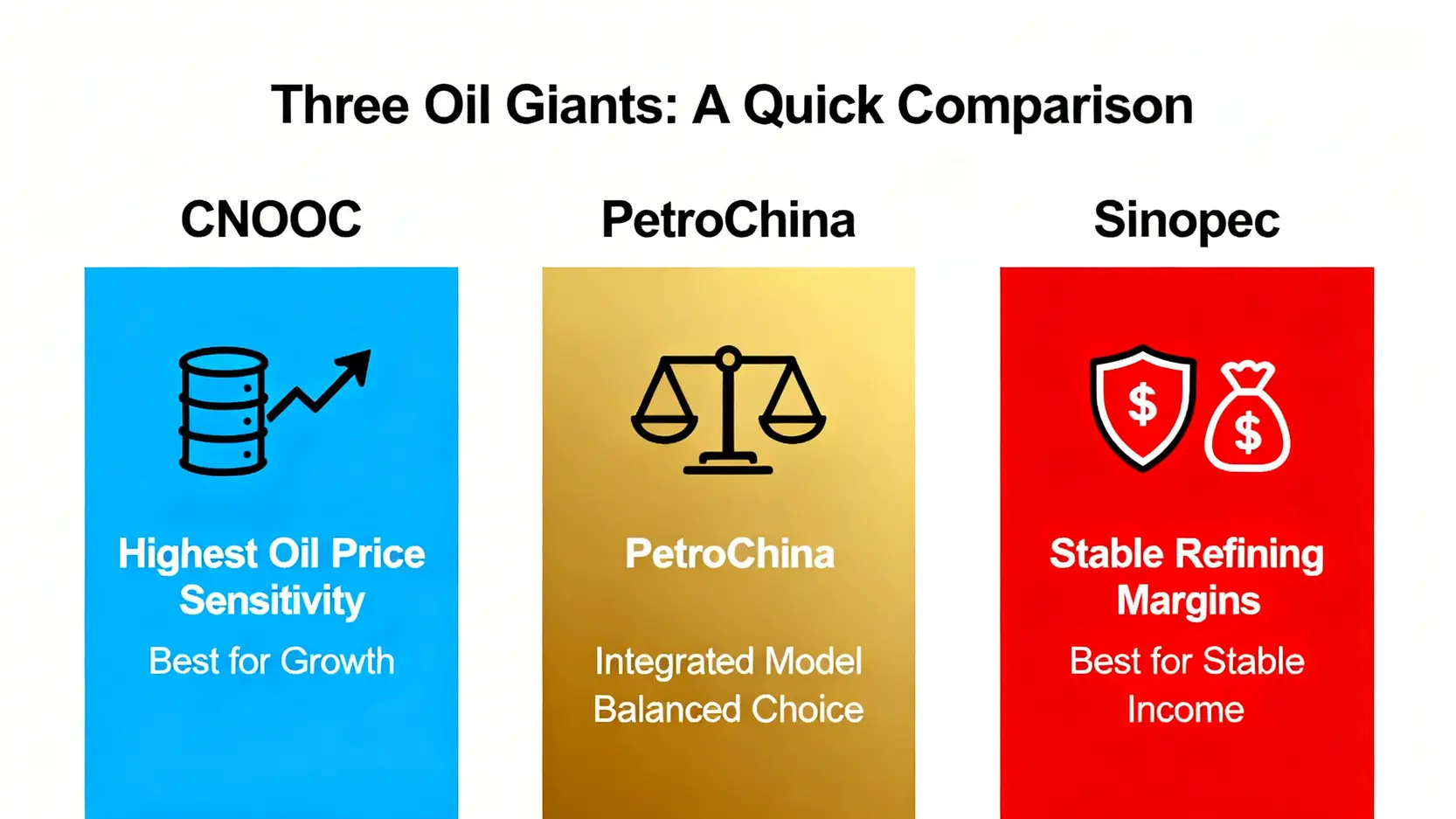
- CNOOC (0883.HK): As a pure upstream producer, its profitability is most closely correlated with oil prices. When international oil prices rise sharply, CNOOC’s profit growth is the most significant, “making it the biggest beneficiary of rising oil prices”. Conversely, it is also the most impacted when oil prices decline.
- Sinopec (0386.HK): It has the most diversified business, with a higher proportion of downstream refining and chemical operations. This gives it a certain “counter-cyclical” adjustment capability. When oil prices fall, its input costs decrease, and refining margins may expand, thereby offsetting losses in upstream operations. As a result, its overall earnings are relatively less sensitive to oil price fluctuations.
- PetroChina (0857.HK): Its integrated business model places it between the two. Its upstream operations benefit from rising oil prices, while its downstream operations provide a buffer during price declines. Overall performance is relatively stable, though its growth potential may be less explosive than CNOOC.

A Quick Guide to Choosing the “Three Major Oil Companies”
Dividend Yield and Payout Policy: Which Is Most Suitable for Income Investing?
For investors whose primary goal is income, dividends are a key consideration. Although payout ratios fluctuate with company earnings and oil prices, historical data and dividend policies remain valuable references.
| Company | Business Focus | Dividend Characteristics | Suitable Investor Type |
| CNOOC (0883.HK) | Upstream exploration and production | Dividends are highly positively correlated with oil prices and relatively volatile | Investors seeking high growth, able to tolerate higher volatility, and optimistic about oil price outlook |
| Sinopec (0386.HK) | Midstream and downstream refining and chemicals | Dividend yield is relatively stable and less affected by oil price fluctuations | Income-focused investors who prefer stable cash flow and have lower risk tolerance |
| PetroChina (0857.HK) | Integrated business model | Dividend performance lies between the two, offering both stability and growth potential | Investors seeking a balanced allocation, who want to benefit from rising oil prices while maintaining some defensive characteristics |
Investment Strategy Suggestions: How Should Conservative and Growth Investors Choose?
Based on the above analysis, the following strategy suggestions can be provided for different types of investors:
- If you are a growth investor: If you are optimistic that international oil prices will continue to rise and are willing to tolerate higher stock price volatility, CNOOC (0883.HK) is undoubtedly your top choice. Its highly elastic earnings model is likely to deliver the most substantial returns.
- If you are a conservative income investor: If you seek stable and predictable cash flow and want to minimize the impact of oil price fluctuations, Sinopec (0386.HK), with its more diversified business and more stable dividends, would be a more suitable option.
- If you are a balanced investor: If you aim to achieve a balance between growth and stability, PetroChina (0857.HK), with the most comprehensive business structure, is worth considering. It can capture opportunities from rising oil prices while providing some level of downside protection during market headwinds.
Frequently Asked Questions About Investing in Hong Kong Oil Stocks (FAQ)
Q: What is the minimum investment required for oil stocks?
A: The entry threshold is relatively affordable. The trading unit in Hong Kong stocks is one “lot”, and the lot size for the “Three Major Oil Companies” is 2,000 shares each. Based on current share prices, the entry cost is approximately several thousand to over ten thousand Hong Kong dollars, depending on the prevailing market price. For beginners, these are relatively accessible blue-chip stocks.
Q: Are there other oil-related stocks in Hong Kong besides the “Three Major Oil Companies”?
A: Yes. In addition to the “Three Major Oil Companies”, there are other oil-related companies in the Hong Kong market, such as oilfield service providers (for example, China Oilfield Services 2883.HK), oil equipment manufacturers, and some smaller exploration companies. However, the “Three Major Oil Companies” remain the largest, most liquid, and most widely followed by institutional investors.
Q: How much do international oil prices affect the share prices of the “Three Major Oil Companies”?
A: The impact is very direct, but varies in degree. As mentioned earlier, CNOOC (0883.HK) is the most sensitive to oil prices, with the strongest correlation between its share price and oil price movements. PetroChina (0857.HK) follows. Sinopec (0386.HK), due to its significant downstream operations, may sometimes benefit from lower input costs when oil prices fall, making it the least sensitive to oil price fluctuations. Investors can choose accordingly based on their outlook on oil prices.
Q: What should I monitor after buying oil stocks?
A: After investing, you should continuously monitor several key indicators: international crude oil prices (such as Brent crude and WTI futures), OPEC+ production decisions, economic data from major global economies (which affect demand), and company dividend policy announcements. These factors directly influence your investment returns.
Conclusion
In summary, investing in Hong Kong oil stocks, particularly by understanding the characteristics of the “Three Major Oil Companies”, is an effective way to achieve capital growth and generate passive income. Each has its own strengths: CNOOC is the most sensitive to oil prices and serves as an aggressive play in a bull market; Sinopec, with its diversified business, is a defensive choice for stable dividends; while PetroChina offers a relatively balanced option. Investors should make decisions based on their risk tolerance, outlook on future oil prices, and expectations for dividend returns. In the ever-changing energy market, closely monitoring international oil prices, geopolitical developments, and industry policies will be key to successful oil stock investing.
Related Articles
-
US PPI Comes in Below Expectations: Is Inflation Cooling? Understand the Impact on the Stock Market, Interest Rate Hikes, and Your Wallet The recently released US Producer Price Index (PPI) once again came in below market expectations, sparking optimism that inflation is cooling. What exactly does this key US PPI...2026 年 7 月 21 日
-
PPI and CPI Surge: Is the Inflation Monster Coming? Understand the Two Key Indicators and Protect Your Wallet! Have you recently felt that your money is worth less and less, with the price of everything rising except your salary? Everyone is talking about “inflation”, but where exactly does this monster...2026 年 7 月 21 日
-
When Oil Prices Rise, Which Currencies Benefit? Understanding Investment Strategies for Crude Oil Currency Pairs What Are Crude Oil Currencies? Uncovering the Relationship Between Oil Prices and Forex As volatility in the global energy market intensifies, every movement in crude oil prices affects the foreign exchange market. For perceptive investors,...2026 年 7 月 21 日