Hong Kong 0DTE Options Beginner’s Guide: 5 Major SPX Strategies, Trading Platforms and Risk Guide
Hearing rumors of “0DTE options” delivering dozens or even hundreds of times returns in a single day makes you tempted, yet worried about losing everything? You are not the only investor facing this dilemma. 0DTE options trading, also known as “same-day expiry options”, is rapidly becoming one of the hottest trading instruments on Wall Street, but its high leverage makes it extremely unfriendly for beginners. This article provides Hong Kong investors with a complete 0DTE trading guide, covering the basic concepts, the most popular SPX 0DTE strategies, how to trade 0DTE in Hong Kong, and most importantly, intraday options risk management, helping you avoid becoming “exit liquidity” in the market and take your first step into high-risk investing safely.
What Are 0DTE Options? A Double-Edged Sword for Overnight Riches
0DTE options, short for “Zero Days to Expiration Options”, literally means “options that expire in zero days”. As the name suggests, this is a type of options contract that expires on the same trading day. For traders pursuing extreme short-term volatility, it offers unmatched leverage and return potential, but it also comes with extremely high risk.
Precise Definition and Mechanics of 0DTE (Same-Day Expiry Options)
In the world of options, every contract has an expiration date. Traditional options may expire weekly, monthly, or quarterly. 0DTE options compress this timeline to the extreme, buy today, settle today. This means traders must make market direction decisions within just a few hours, and any hesitation or mistake may result in the complete loss of the premium invested. Its core mechanism lies in capturing intraday price movements of indices or stocks and amplifying them through the leverage effect of options.
Why Has 0DTE Become So Popular in Recent Years?
The rise of 0DTE is not accidental, and is mainly driven by the following reasons:
Increased product availability: Taking the US market as an example, the Chicago Board Options Exchange (CBOE) has in recent years launched options contracts for major indices such as the S&P 500 Index (SPX) with expirations available from Monday to Friday, creating the perfect environment for 0DTE trading.
Extremely high capital efficiency: Due to the imminent expiration, the premium (price) of these options is relatively low. Traders can use a smaller amount of capital to control a large contract value, achieving the possibility of “small capital, large exposure”.
Alignment with the intraday trading trend: More retail and institutional investors are focusing on intraday trading, seeking to avoid overnight positions and reduce exposure to black swan events. 0DTE perfectly fits this trading style.
Core Differences Between 0DTE and Traditional Longer-Term Options
To help you better understand, here is a direct comparison between 0DTE and traditional options (for example, those with more than 30 days to expiration):
Characteristics
0DTE Options (Same-Day Expiry Options)
Traditional Longer-Term Options
Time Value (Theta)
Extremely fast decay, with a cliff-like decline
Slower decay, with a gradual curve
Price Sensitivity (Gamma)
Extremely high, even small movements in the underlying asset can cause significant fluctuations in option prices
Relatively low, with more linear price movement
Primary Use
Intraday speculation, capturing large intraday volatility, hedging same-day event risk
Swing trading, long-term hedging, earning time value
Margin for Error
Extremely low, if direction or timing is wrong, the premium may nearly go to zero immediately
Relatively high, with sufficient time to wait for the market to move back in a favorable direction
Psychological Pressure
Extremely high, requires high-pressure decision-making within a very short time frame
Relatively low
0DTE Options Core Risks: It Is Not Just About Expiring Worthless
Many beginners are attracted by stories of 100x returns from 0DTE trading, but overlook the massive intraday options risks behind it. These risks are not limited to premium decay to zero; they also involve advanced options concepts that, if not properly understood, can easily lead to devastating losses.
Extreme Time Decay (Theta Decay): A Race Against Time
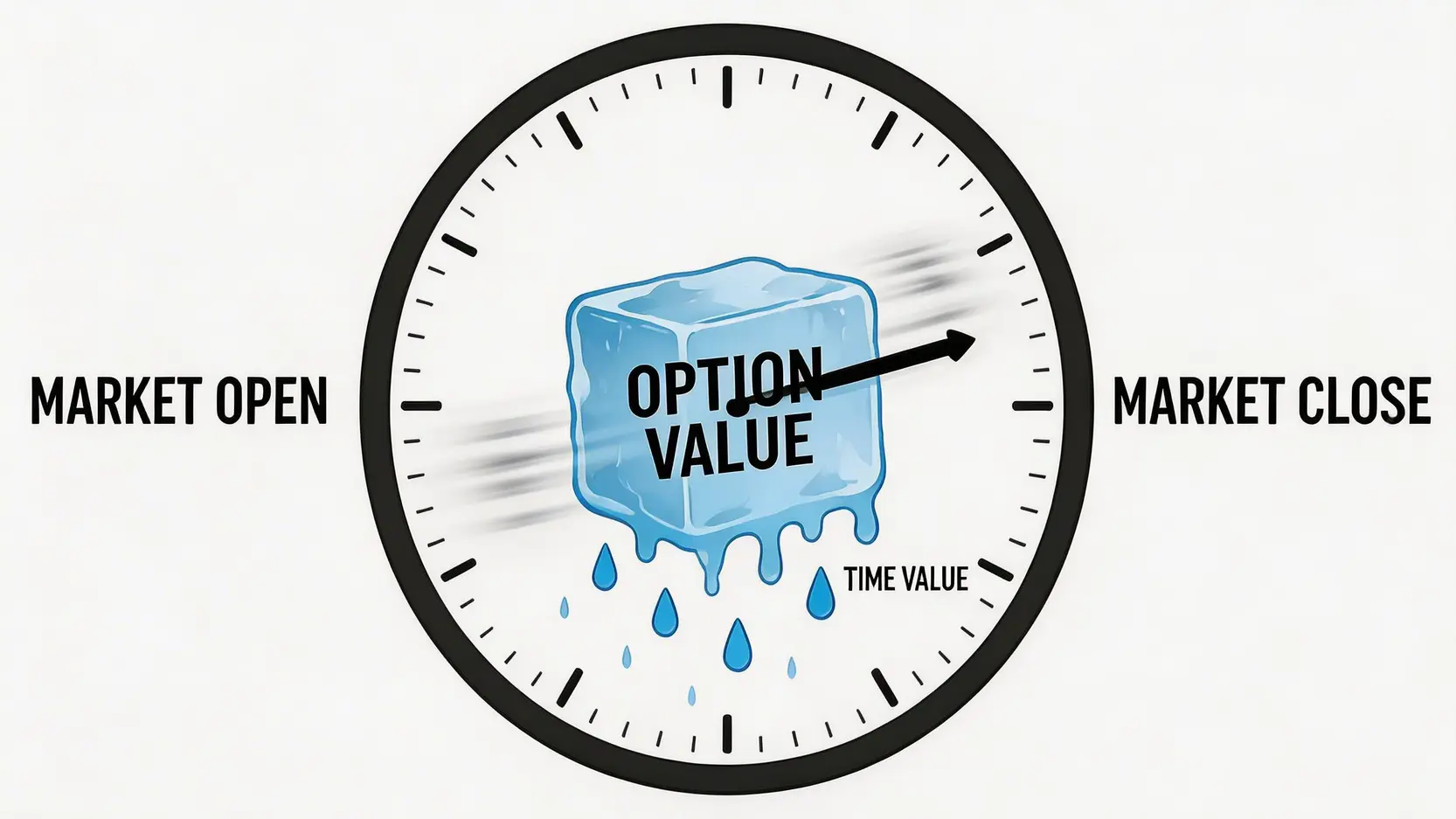
Theta measures the rate at which an option loses value due to the passage of time. For 0DTE options, Theta is the biggest enemy. Imagine your option like an ice cube melting rapidly from the moment the market opens. Its time value is continuously eroding every second, even if the underlying price does not move, and it will eventually expire worthless at the close. This means that when buying 0DTE options, you not only need to be right about direction, but you must also be right within an extremely short time window!
The time value (Theta) of 0DTE options is like a melting ice cube, rapidly decaying as time passes.
Explosive Gamma Risk: Small Price Movements Can Amplify Losses Instantly
Gamma measures the rate of change in an option’s Delta (directional risk). In 0DTE trading, Gamma becomes extremely large. What does this lead to?
For buyers: If the market moves quickly in your favor, high Gamma accelerates your profit growth, which is part of its appeal.
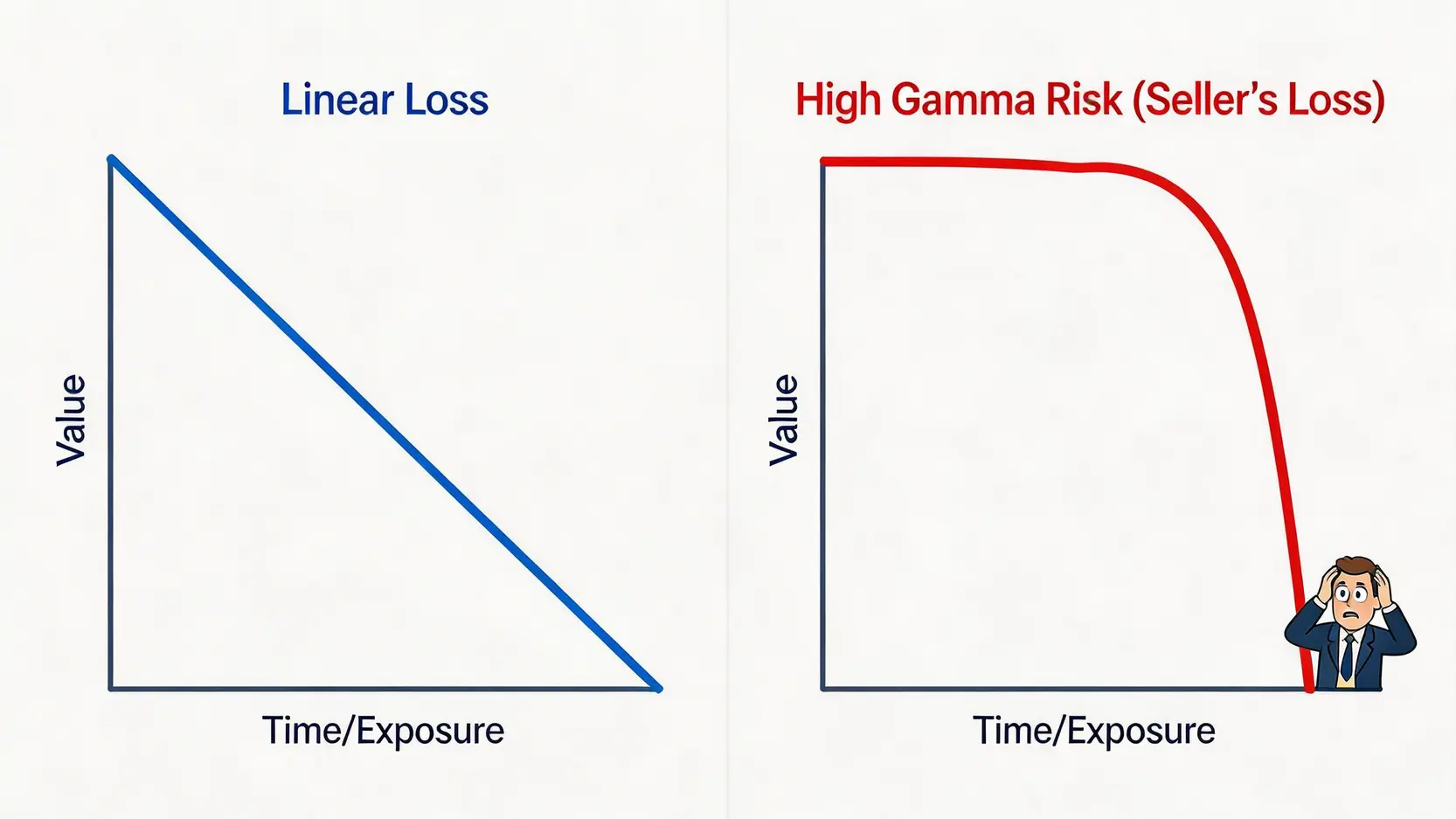
For sellers: High Gamma is a nightmare. If the market moves against your position, losses can accelerate in a highly non-linear way. A seemingly small price movement may instantly turn a profitable position into a significant loss. This is also why naked selling of 0DTE options is considered extremely dangerous.
Under high Gamma risk, seller losses accelerate non-linearly, with risk far exceeding expectations.
Liquidity Traps and Slippage Issues
Although 0DTE options on major indices such as SPX generally have good liquidity, liquidity can disappear instantly for deep out-of-the-money contracts or during periods of extreme market volatility. This leads to:
Widened bid-ask spreads: The gap between buying and selling prices increases, raising trading costs invisibly.
Severe slippage: The actual execution price may differ significantly from the quoted price, especially when using market orders. This can result in unexpected losses when entering or exiting positions.
How Hong Kong Investors Trade 0DTE? Platforms and Account Opening Guide
After understanding the concepts and risks of 0DTE, the next practical question is: how can investors in Hong Kong trade 0DTE? Although Hong Kong does not currently offer directly equivalent products, investors can easily access this market through international brokers that support US stock options trading.
Why Does Hong Kong Not Yet Offer 0DTE Products?
The Hong Kong Stock Exchange (HKEX) derivatives market mainly focuses on Hang Seng Index futures and options. Its product structure and market design differ from the US market. Hong Kong options typically expire monthly and have not introduced daily-expiry products. This is due to regulatory considerations, market demand, and investor structure. Therefore, to trade 0DTE, investors must look to the US market.
Top 3 Popular US Options Trading Platforms for Hong Kong Investors
For Hong Kong investors, choosing a stable, cost-effective, and powerful trading platform is crucial. Below are three popular platforms in Hong Kong that support US options trading:
Platform
Advantages
Disadvantages
Suitable For
Interactive Brokers (IBKR)
Most professional features, a wide range of trading instruments, low commissions, and a powerful API interface
The platform interface is relatively complex and not beginner-friendly
Professional traders, high-frequency traders, investors with high requirements for trading tools
Futu (Futu NiuNiu)
User-friendly Chinese interface, active community features, easy account opening, and free real-time quotes
Relatively higher options commissions compared to IBKR
Beginners and intermediate investors who value user experience and community interaction
Moomoo
Similar to Futu, with a clean interface and some unique analytical tools
Market depth and certain advanced features may be less comprehensive than IBKR
Beginners and investors with high demand for mobile trading
Account Setup: Steps and Requirements to Enable Options Trading Permissions
No matter which platform you choose, enabling options trading permissions is a separate step. The typical process is as follows:
Log in to your account dashboard: Find options such as “Account Settings” or “Trading Permissions” on the broker’s website or app.
Apply for options trading: Select to enable options trading, and the system will guide you to complete a questionnaire.
Fill in the investment experience questionnaire: This usually includes your years of investing experience, trading frequency, understanding of options, and financial situation. Please make sure to answer honestly, as this determines the level of options trading approval granted by the broker.
Sign risk disclosure documents: You will need to read and agree to a statement regarding the high risks of options trading.
Wait for approval: After submission, brokers usually complete the review within 1 to 3 business days.
Note: Brokers will grant different levels of options permissions based on your experience and asset situation. For example, the lowest level may only allow buying call/put options (Long Call/Put), while higher levels may allow selling options or executing complex spread strategies.
5 SPX 0DTE Strategies from Beginner to Advanced
SPX (S&P 500 Index) is one of the most actively traded 0DTE instruments, widely favored for its cash settlement (no need to worry about stock assignment) and high liquidity. Below are five commonly used SPX 0DTE strategies, ranging from beginner to advanced, to help you progressively master 0DTE options trading.
Beginner Level: Long Call / Put Options
Strategy Core: The most direct directional strategy. When you are strongly bullish on a sharp intraday rise, you buy a call option (Long Call); when you are strongly bearish on a sharp intraday drop, you buy a put option (Long Put).
When to Use: Typically used before major economic data releases or when there are clear signs of a one-sided market breakout.
Risk and Advantage: Limited risk (maximum loss is the premium paid), with theoretically unlimited profit potential. However, the downside is a relatively low win rate, as you must be correct in both direction and timing to overcome Theta decay.
Collecting Premium: Credit Spreads
Strategy Core: Compared to naked option selling, this is a more controlled income strategy. It includes two types: – Bull Put Spread: Sell a higher strike put and buy a lower strike put. As long as the index closes above the sold put strike, you keep the full premium. – Bear Call Spread: Sell a lower strike call and buy a higher strike call. As long as the index closes below the sold call strike, you keep the full premium.
When to Use: When you do not have a strong directional view but expect the market not to break a key support or resistance level.
Risk and Advantage: Both risk and reward are predefined, with relatively higher win probability. The downside is capped profit and margin requirements.
Range Strategy: Iron Condor
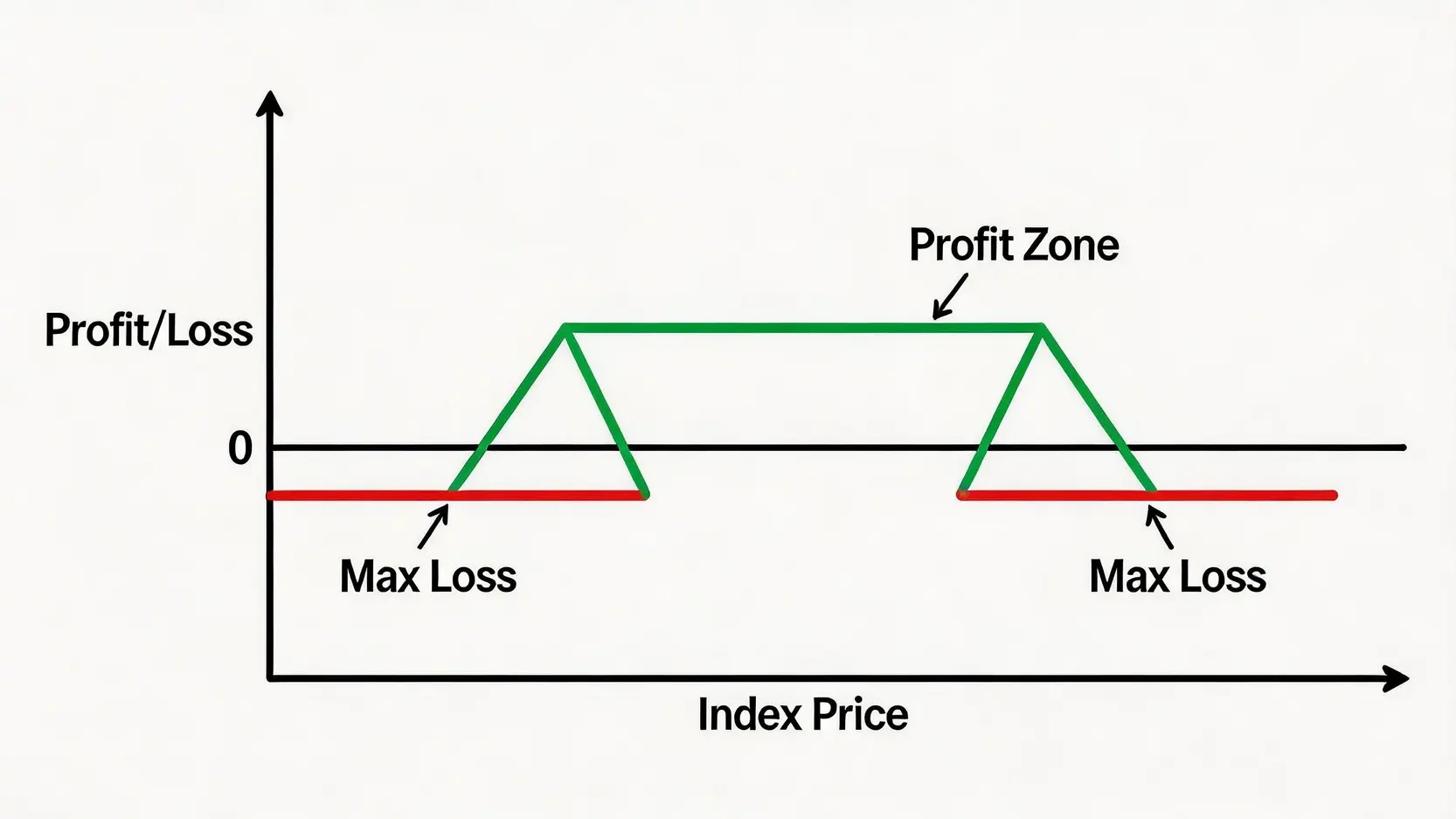
Strategy Core: This strategy combines the two credit spreads above, selling both a Bull Put Spread and a Bear Call Spread at the same time. Essentially, it bets that the market will stay within a defined price range.
The payoff diagram of an Iron Condor shows profitability within a preset range.
When to Use: When you expect low intraday volatility and the market to stay between support and resistance levels.
Risk and Advantage: Profit is achieved if the market closes within the defined range. This is a high-probability strategy, but it requires the market to remain relatively “quiet”. Unexpected large moves outside the range will result in losses.
Advanced Application: Intraday Trend-Following and Reversal Strategies
Once you are familiar with basic strategies, you can explore more flexible approaches combining technical analysis:
Trend Following: When the index breaks a key intraday technical level (such as the opening high/low), you can buy calls or puts to ride the trend. This requires fast reaction and strict stop-loss discipline.
Reversal Strategy: When the index reaches a strong support or resistance level, you can trade in the opposite direction, for example by selling a nearby credit spread to bet on a reversal. This requires strong market timing skills.
Before starting real trading, make sure to learn more about options trading basics. You can refer to an options trading beginner guide to build a solid foundation.
FAQ: Common Questions About 0DTE Options
Q: How much capital is needed to trade 0DTE options?
A: In theory, you can buy a far out-of-the-money 0DTE option with just tens of dollars, making the entry barrier very low. However, this is also the trap. For beginners, it is recommended to have at least 1,000 to 2,000 US dollars as starting capital, and strictly limit the risk per trade (such as premium paid) to 1 to 2 percent of total capital. Never adopt an “all-in” mindset.
Q: What is the difference between SPX, SPY, and QQQ 0DTE trading?
A: SPX is the index itself, cash-settled, with no risk of stock assignment, and has large contract value, making it the preferred choice for professional traders. SPY and QQQ track the S&P 500 and Nasdaq 100 ETFs respectively. They are physically settled, meaning you may be assigned shares if options expire in-the-money. In addition, SPY and QQQ contracts are much smaller in size, making them more suitable for smaller accounts.
Q: Can 0DTE cause the next market crash?
A: This is a widely debated topic on Wall Street. Some argue that massive 0DTE trading, especially hedging activity from option sellers managing Gamma risk, may amplify volatility at certain times and create a “Gamma Squeeze”, thereby intensifying market swings. Although there is no definitive conclusion yet, this potential systemic risk does exist. For more official information on 0DTE, you may refer to CBOE materials.
Q: Do Hong Kong investors need to consider time zone differences when trading 0DTE options?
A: Absolutely. The US market trading hours correspond to nighttime in Hong Kong. Regular trading hours are from 9:30 PM to 4:00 AM Hong Kong time (Daylight Saving Time). This means you may need to stay up late to monitor the market, which can significantly affect your daily routine. You must consider whether this fits your lifestyle.
Conclusion
In summary, 0DTE options offer a high-return potential intraday trading tool, but the underlying intraday options risks should never be ignored. It is like a sharp surgical knife, capable of creating miracles in expert hands, but easily causing harm in inexperienced hands. This article has covered concepts, risk management, how to trade in Hong Kong, and key SPX 0DTE strategies, aiming to help you build a solid foundation. Before committing real capital, it is strongly recommended to practice with a demo account and choose a reputable trading platform. A well-structured investment risk management strategy is the only true safeguard in this high-risk market.
How to Get Started with Bitcoin? The Complete 2026 Bitcoin Buying Guide for Beginners After watching Bitcoin repeatedly reach new highs in recent years and successfully pass spot ETF reviews in the US and Hong Kong in 2024, officially entering mainstream financial markets, many investors have turned their attention to...
Is Gold’s V-Shaped Rebound a Bottom-Fishing Signal? A Complete Guide to Trading Strategies Amid “$100 Price Swings” What Is a Gold V-Shaped Rebound? More Than Just a Technical Pattern The gold market has recently experienced sharp rises and falls, with prices frequently displaying dramatic “gold V-shaped rebounds”. Single-day “$100 price...
What Is PPI Data? 2026 Latest Analysis: Understand the Differences from CPI and How It Affects Stock Market Trends With market information constantly changing, do you always hold your breath while waiting for CPI data to be released? But did you know that a more forward-looking inflation indicator, PPI data...