What Are ADR US Stocks? Hong Kong Guide & Risks

Updated: 2026/03/02  |  CashbackIsland

ADR美股係咩?香港ADR報價、中概股風險及買ADR方法全攻略

What Are ADR US Stocks? A Complete Guide to Hong Kong ADR Quotes, China Concept Stock Risks, and How to Buy ADRs

What are ADR US stocks? Understand American Depositary Receipts in three minutes

Want to invest in China concept stocks such as Tencent and Alibaba listed in the US, but often hear “ADR” without knowing what it is? Worried about buying the wrong thing and taking on risk, and do not know how to read Hong Kong ADR quotes? In fact, ADRs are not something to fear, but a tool that allows global investors to conveniently buy and sell shares of non-US companies. This article starts from zero and explains in detail what ADR US stocks are, provides an in-depth analysis of potential China concept stock ADR risks, and offers a clear tutorial on how to buy ADRs, helping you master the key points of cross-border investing with ease. 


Full Definition of ADR: Why Do Foreign Companies Issue ADRs in the US?

ADR (American Depositary Receipt), with the Chinese full name “美国存托凭证”, is essentially a negotiable security issued by a US depositary bank (such as Citibank or The Bank of New York Mellon). It represents shares of a foreign company (a non-US company). Simply put, you can think of an ADR as a “receipt” proving that you indirectly hold shares of that foreign company.

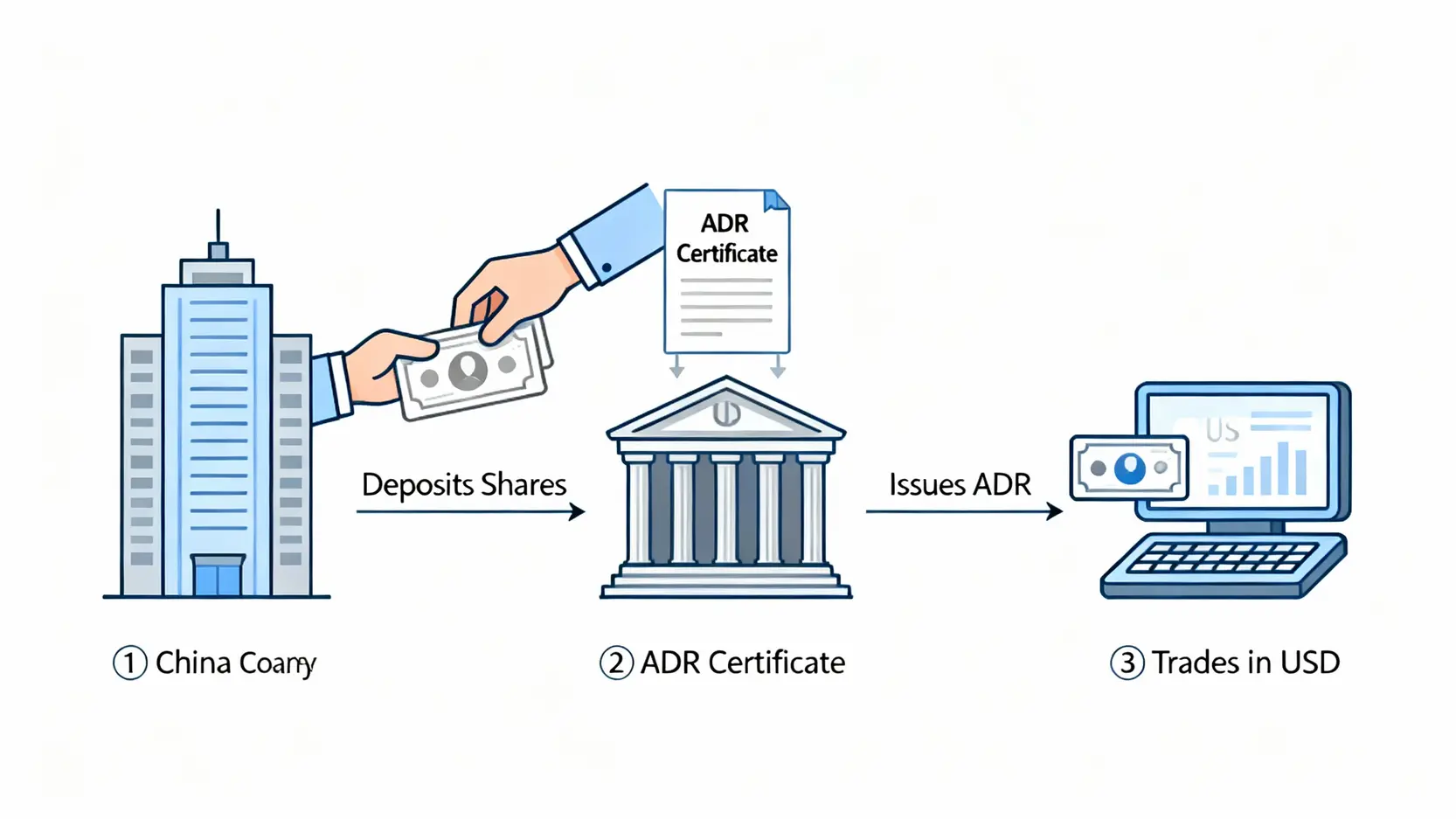
ADR運作原理流程圖,展示外國公司股票如何透過存託銀行轉換為美國存託憑證。

ADR operating process: Foreign company shares are converted into receipts traded in the US market through a depositary bank.

Why Do We Need ADRs?

  • Simplified investment process: For US investors, directly buying overseas stocks is cumbersome, involving cross-border remittances, time differences, and different trading rules. ADRs are quoted and traded in US dollars on US exchanges (such as the NYSE and NASDAQ). The process is no different from trading ordinary US stocks, significantly lowering the investment barrier.
  • Expanded corporate financing channels: For foreign companies, issuing ADRs is equivalent to listing in the US, the world’s largest capital market. It can attract more US investors, enhance international brand recognition and stock liquidity, and open up new financing channels.
  • Greater global visibility: Being listed on major US exchanges is itself an endorsement of corporate governance and financial transparency, helping enhance a company’s global image.


Differences Between ADRs and Ordinary Shares: How Do Rights and Dividends Differ?

Although ADRs represent company shares, there are still some subtle differences in shareholder rights compared with directly holding ordinary shares. You must understand these clearly before investing:

Item

ADR (American Depositary Receipt)

Ordinary Shares
Ownership Indirect ownership. The underlying shares are held by the depositary bank, while investors hold the receipts. Direct ownership, with your name listed on the shareholder register.
Trading Currency US dollars (USD) The company’s local currency (for example, Hong Kong stocks use HKD).
Dividend Distribution The company first pays dividends to the depositary bank. After deducting custody fees and currency conversion costs, the bank distributes the dividends to ADR holders in US dollars. Dividends are paid directly to shareholders in the local currency.
Shareholder Rights Voting rights are usually exercised by the depositary bank on behalf of holders, or exercised according to instructions. Rights may be subject to limitations. Full shareholder rights, including voting rights and the right to attend shareholders’ meetings.

In summary, the core reason for buying ADRs is trading convenience, but this comes with a slight trade-off in the completeness of shareholder rights.


How to Read Hong Kong ADR Quotes? ADR-to-Hong Kong Stock Price Conversion Guide

For Hong Kong investors, the most important function of ADR quotes is to serve as a reference indicator before the Hong Kong stock market opens. Because US stock trading hours fall during the night in Hong Kong, price movements in ADRs often signal the opening direction of the corresponding Hong Kong stocks the next day. Therefore, learning how to interpret and convert Hong Kong ADR quotes is essential.


Recommended Tools for Checking Real-Time ADR Quotes

To check real-time ADR quotes, you can use major financial websites. These platforms usually calculate the corresponding estimated Hong Kong stock opening price based on the conversion ratio and real-time exchange rate, and display the price change compared with the previous Hong Kong market close. Many financial websites offer this feature. For example, SL886 Financial Network is a popular choice, with clear and easy-to-understand information.

ADR Conversion Formula: How to Calculate the Corresponding Hong Kong Stock Value? (With Example)

If you want to calculate it yourself, it is very simple. You only need to know three key figures: the ADR market price, the conversion ratio between the ADR and the Hong Kong stock, and the USD to HKD exchange rate.

The conversion formula is as follows:

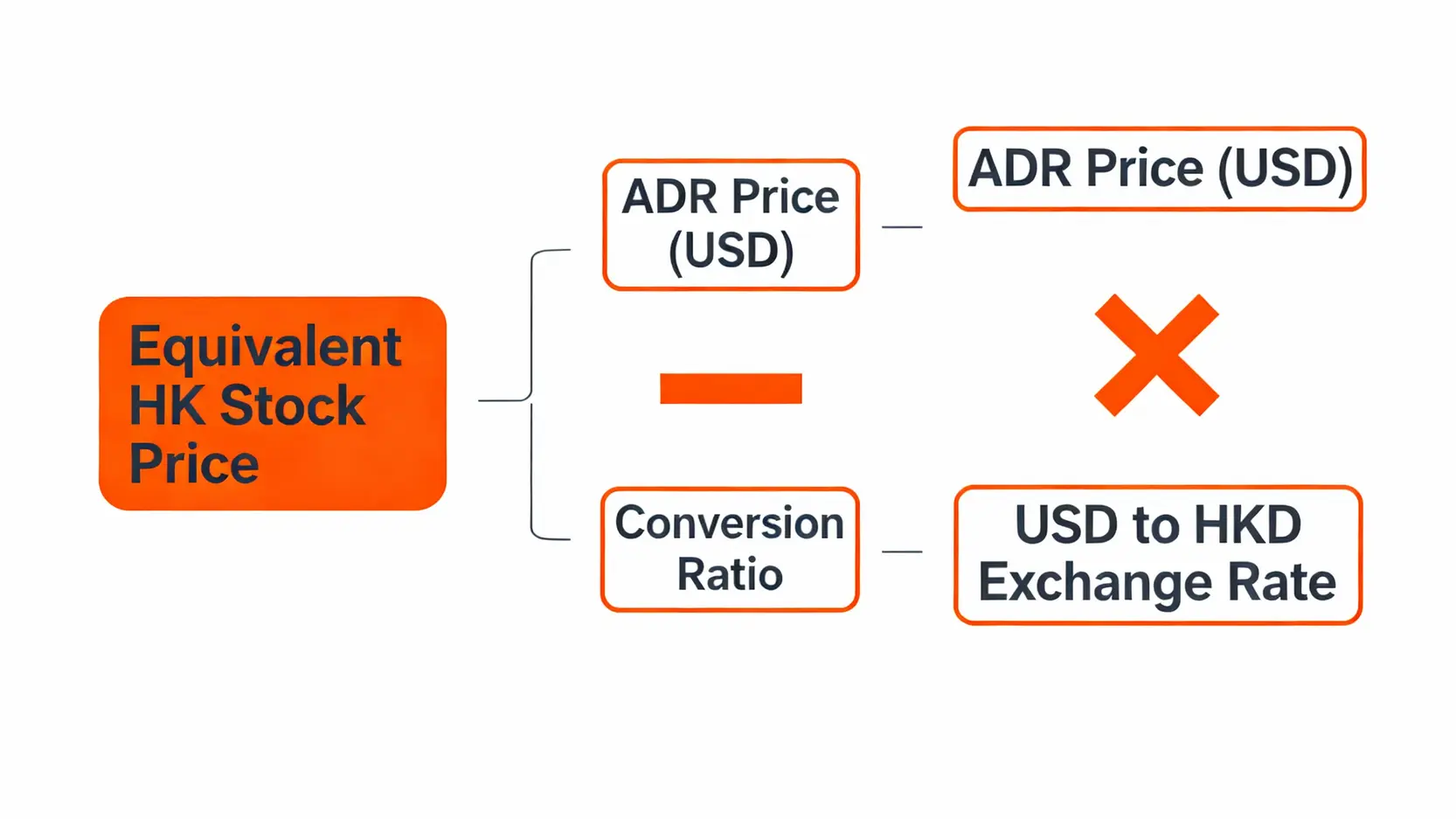
ADR換算港股價格公式示意圖。

ADR to Hong Kong stock conversion formula: Divide the ADR price by the conversion ratio, then multiply by the exchange rate to obtain the corresponding Hong Kong stock price.

Estimated corresponding Hong Kong stock price = (ADR market price ÷ number of shares per ADR) × USD to HKD exchange rate

[Example Tutorial: Using Alibaba as an Example]

  • Assume that the ADR market price of Alibaba (BABA.US) is USD 80.
  • Its conversion ratio between the ADR and the Hong Kong stock (9988.HK) is 1 ADR share = 8 Hong Kong shares.
  • Assume that the USD to HKD exchange rate at the time is 7.8.

Calculation steps:

  1. Calculate the ADR price equivalent per Hong Kong share: USD 80 ÷ 8 = USD 10
  2. Convert the USD price into HKD: USD 10 × 7.8 = HKD 78

Conclusion: When the Alibaba ADR price is USD 80, the theoretical corresponding Hong Kong stock price is approximately HKD 78 per share. If the Hong Kong stock closing price at that time was HKD 75, this means the ADR is trading at a premium, which may indicate that the Hong Kong stock could open higher the next day.


[Must-Read for Investors] Three Key Risks of China Concept Stock ADRs

Although buying ADRs is convenient, you must clearly understand the risks before investing, especially for China concept stock ADRs, which have faced a number of unique challenges and risks in recent years. Ignoring these potential risks may lead to serious investment losses.

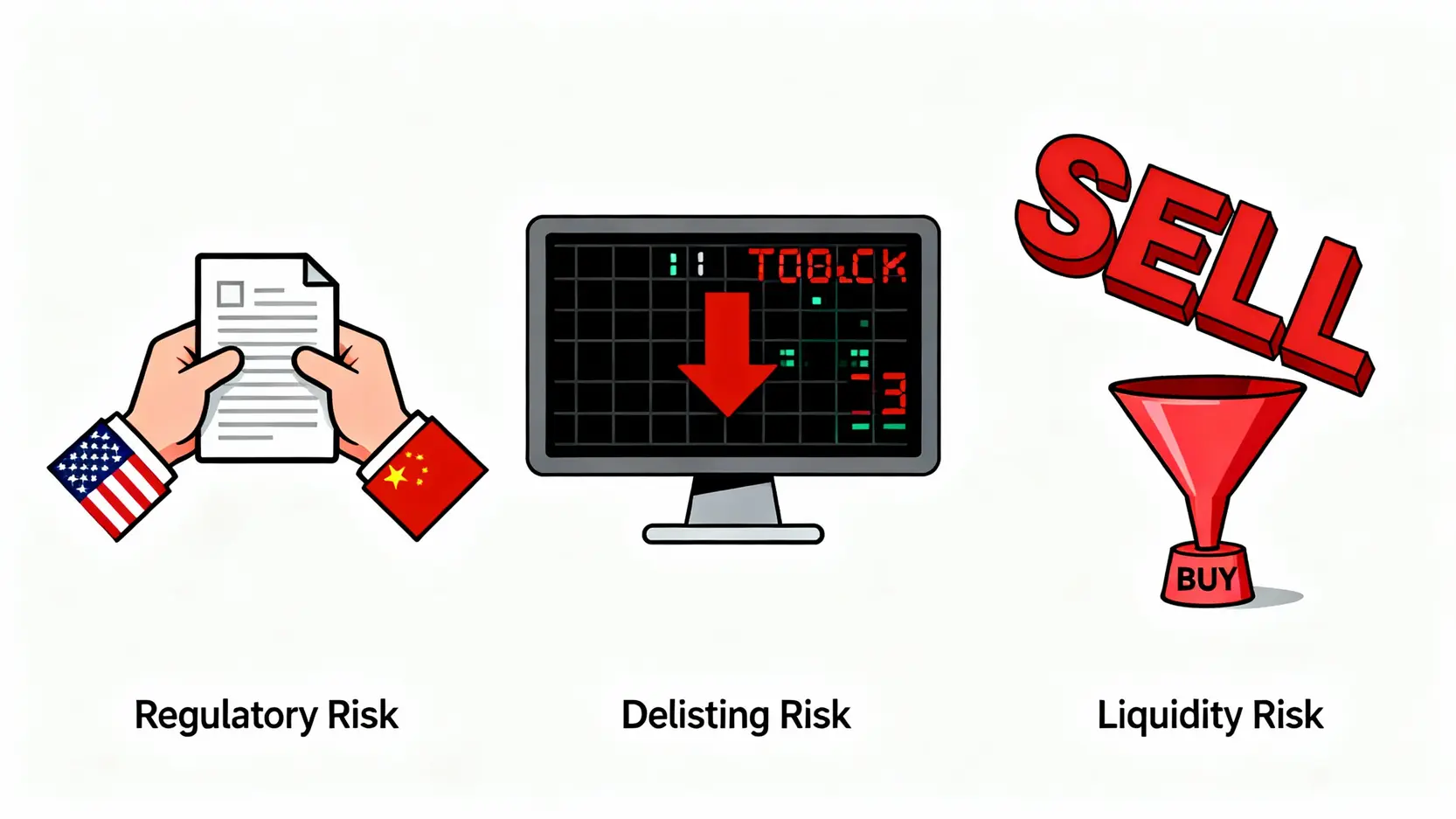
中概股ADR的三大投資風險圖示:監管風險、除牌風險及流動性風險。

Before investing in China concept stock ADRs, you must pay attention to three key risks: regulation, delisting, and liquidity.


Regulatory and Policy Risk: How Do US-China Relations Affect ADR Value?

This is currently the largest source of uncertainty for China concept stock ADRs. Trade, technology, and financial tensions between China and the US may evolve into regulatory policies targeting China concept stocks. For example, tighter Mainland regulation over specific industries (such as education and technology), can directly impact a company’s earnings outlook and cause ADR share prices to plunge. Likewise, policy shifts by US regulators may also threaten the listing status of China concept stocks.


Delisting Risk: Understanding the Impact of the Holding “Foreign Companies Accountable Act”

In 2020, the US passed the “Holding Foreign Companies Accountable Act” (HFCAA), requiring foreign companies listed in the US to submit their audit work papers from their accounting firms to the Public Company Accounting Oversight Board (PCAOB) for inspection. If the company fails to meet the requirements for three consecutive years, its securities will be prohibited from trading in the US, meaning it faces “delisting” risk.

Although China and the US have reached a preliminary cooperation arrangement on audit oversight, temporarily easing the risk of large-scale delistings, this risk has not been fully eliminated. Any setback in cooperation could once again trigger market concerns about China concept stock ADR risk.


Market Liquidity and Spread Risk

Compared with their primary listings in Hong Kong or the Mainland, some smaller or less well-known China concept stock ADRs may not trade actively in the US market. This can lead to two issues:

  • Liquidity risk: When you want to sell a large position, there may be insufficient buy-side demand in the market, making it difficult to execute, or forcing you to sell at a much lower price.
  • Wider bid-ask spreads: Insufficient liquidity usually means the gap between the ask price and the bid price widens, which increases your trading costs.


Beginners Must Learn: Four Steps for Buying ADRs

After understanding the basics and risks of ADRs, the actual process is quite simple. Essentially, as long as you have a brokerage account that allows you to trade US stocks, you can easily buy ADRs. Below are the four basic steps:


Step One: Choose a Suitable Brokerage Account (Hong Kong Brokers vs. Overseas US Stock Brokers)

To buy ADRs, you first need a brokerage account. There are two main options:

  • Hong Kong brokers: Most local Hong Kong brokers or banks offer US stock trading services (often referred to as “sub-brokerage”). The advantages are convenient fund transfers, a familiar account opening process, and local customer support. The disadvantages are that trading commissions and platform fees may be higher.
  • Overseas US stock brokers: Such as Interactive Brokers (IB), Futu, and Webull. These brokers focus on global markets and usually offer lower trading commissions, or even commission-free trading, with more professional platform features. The disadvantages are that funds need to be remitted overseas, and additional documents may be required during account opening.


Further Reading (Highly Recommended)

[2025 Hong Kong Securities Firm Rankings] Top 10 Broker Recommendations: Fees and Account Opening Offers

2026 Hong Kong US Stock Investment Guide: Fees and Account Opening at a Glance, Easy for Beginners! 

Step Two: Deposit Funds and Convert to US Dollars

After selecting a broker and completing account opening, you need to deposit funds. If you use a Hong Kong broker, you can deposit Hong Kong dollars directly and then convert HKD into USD within the trading platform. If you use an overseas broker, you may need to transfer funds to your brokerage account via bank wire. Note that when converting currencies, the platform will charge a certain exchange rate spread.


Step Three: Search for the Desired ADR Ticker and Place an Order

Once the funds are credited, you can start trading. In the search bar of the broker’s platform, enter the ADR ticker symbol you want to buy. For example:

  • Alibaba: BABA
  • Tencent Holdings ADR: TCEHY (traded on the OTC market)
  • JD.com: JD
  • Baidu: BIDU

After finding your target, enter the number of shares and the price you wish to buy (you may choose a market order or a limit order). Confirm the order to complete the trade.


Step Four: Manage Your ADR Position and Dividend Income

After a successful purchase, you will be able to see your ADRs in your portfolio. You should then continue to monitor the share price performance and related company news. If the company pays dividends, the broker will handle the process automatically. The dividends you receive will be the net amount after deducting the 30% US dividend tax and depositary fees, and will be credited to your account in US dollars.


Frequently Asked Questions About ADR Investing (FAQ)

Q: Does buying an ADR mean directly holding the company’s shares?

A: Not entirely. Buying an ADR means you hold a receipt issued by a depositary bank, while the bank is the actual holder of the underlying shares. This is a form of indirect ownership. Although you still enjoy capital gains from price movements and dividend income, certain shareholder rights, such as voting rights, may be restricted.

Q: Are dividends from ADRs subject to tax? What is the tax rate?

A: Yes. Since ADRs are securities traded in the US market, dividends distributed are treated as US-source income and are subject to US dividend withholding tax. For non-US tax residents (such as Hong Kong investors), the tax rate is usually 30%. The dividends you receive will be the net amount after tax.

Q: Do all companies listed in Hong Kong have ADRs?

A: No. Not all Hong Kong-listed companies issue ADRs. A company must actively choose to establish an ADR program and appoint a depositary bank to handle it, which involves certain costs and legal compliance procedures. Therefore, typically only larger companies that wish to expand their international investor base issue ADRs.

Q: What happens if an ADR is delisted?

A: If an ADR is delisted from an exchange due to failure to meet regulatory requirements, your investment does not necessarily become worthless. There are usually several possible outcomes: 1) your broker may assist you in converting the ADR into the corresponding Hong Kong-listed shares (possibly subject to fees); 2) the ADR may move to over-the-counter trading, where liquidity will be significantly lower; 3) In the worst-case scenario, if conversion or trading is not possible, the asset value may be severely impaired.


Conclusion

In summary, ADRs provide Hong Kong investors with a convenient channel to invest in China concept stocks listed on the US market. After understanding what ADRs are, how to check quotes, and how to buy ADRs, it is even more important to remain vigilant and continuously assess the potential risks of China concept stock ADRs, especially uncertainties related to policy and regulation. As long as you do your homework and carefully weigh the pros and cons, ADRs can still serve as a powerful tool within your global asset allocation strategy.

If you liked this article, please share it!

Related Articles

  • Volatility Surface Guide: Skew Trading Strategies
    Practical Applications of Volatility Surfaces: From Options Modeling to Advanced Skew Trading Strategies In options markets, implied volatility is never a flat line. Instead, it forms complex "smile" or "skew" surfaces. For advanced traders, mastering the practical applications of volatility surfaces is equivalent to possessing a lens that reveals market...
    2026 年 6 月 3 日
  • Foreign Capital Flow Model: Track Institutional Money
    Building a Foreign Capital Flow Copy Trading Model: A Stock Market Indicator for Accurately Tracking Institutional Positioning In Asia-Pacific stock markets, foreign capital inflows and outflows often determine the direction of the index. However, simply looking at daily net buy and sell data is no longer enough. Only by building...
    2026 年 6 月 3 日
  • Options Buying Strategies for Extreme Market Risks
    Options Buyer Strategies During Extreme Market Conditions: Black Swan Hedging and Cross-Market Arbitrage During Volatility Surges The most terrifying aspect of financial markets is not a gradual decline, but overnight flash crashes and cross-market capital withdrawals accompanied by volatility surges. In the highly unpredictable global macroeconomic environment of 2026, geopolitical...
    2026 年 6 月 3 日
返回顶部