Taiwan Dollar Impact: Tech Stock FX Sensitivity Guide

Updated: 2026/06/05  |  CashbackIsland

tech-stock-exchange-rate-sensitivity

Technology Stock Exchange Rate Sensitivity Explained: How Taiwan Dollar Appreciation and Depreciation Affect Your Stocks

Have you ever wondered why a technology company can report record-high revenue and impressive earnings, yet its stock price falls simply because the Taiwan dollar appreciates? Or why a company’s stock can surge despite a weak market environment, just because the Taiwan dollar depreciates? Behind the scenes, the invisible force at work is “technology stock exchange rate sensitivity“. For Taiwan’s export-oriented technology sector, even small currency fluctuations can affect profits by hundreds of millions, significantly impacting gross margins and ultimately shareholder equity. Understanding foreign exchange losses and foreign exchange gains is an essential lesson for every investor.

This article will guide you from the ground up, explaining how exchange rates affect technology company profitability, how to evaluate a company’s exchange rate sensitivity, and what investment strategies to adopt during different currency cycles. Whether you are a beginner or an experienced investor, mastering this concept can help you avoid earnings-season pitfalls and uncover investment opportunities that the market may have unfairly discounted due to exchange rate movements.


Understanding the Basics: What Is Exchange Rate Sensitivity and Why Is It Important for Technology Stocks?

Simply put, “exchange rate sensitivity” refers to the degree to which a company’s profits, particularly its gross margin and net income, are affected by fluctuations between its primary transaction currency (such as the US dollar) and its domestic currency (the Taiwan dollar). The greater the impact, the higher the company’s exchange rate sensitivity.

For Taiwan’s technology companies, this is particularly important. Most technology products, from chips and servers to iPhone assembly, are priced in US dollars and sold overseas. However, local operating expenses such as employee salaries, factory rent, utilities, and purchases from domestic suppliers are paid in Taiwan dollars. This business model of “receiving US dollars and paying Taiwan dollars” creates foreign exchange exposure. 


Foreign Exchange Gains and Losses: The Hidden Details in Financial Statements

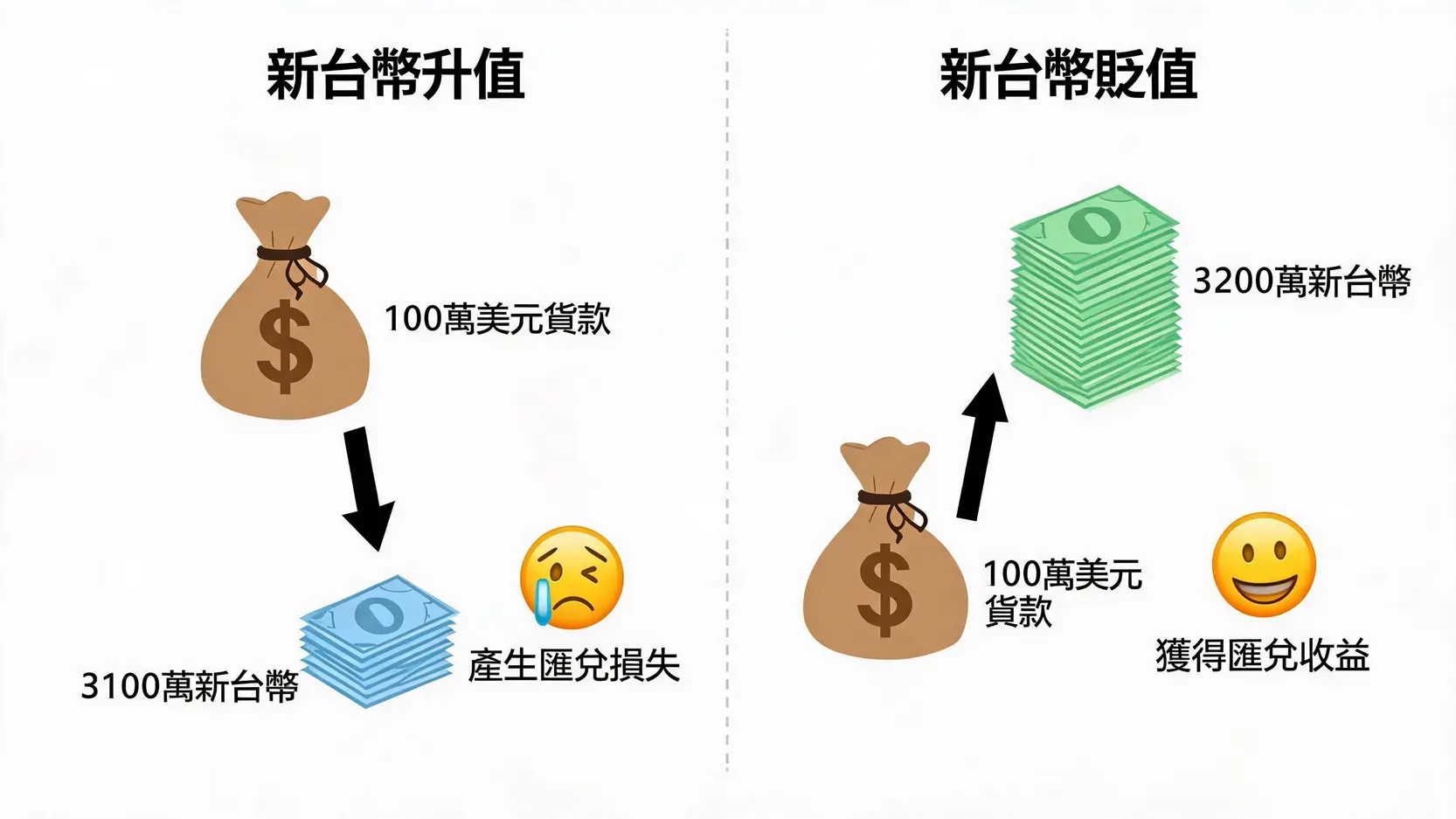
When the Taiwan dollar appreciates against the US dollar (for example, from NT$32 per US dollar to NT$31 per US dollar), an exporter receiving the same US$1 million payment will see its Taiwan dollar proceeds fall from NT$32 million to NT$31 million, effectively losing NT$1 million. In accounting terms, this reduction is recorded as a foreign “exchange loss”.

Conversely, when the Taiwan dollar depreciates (for example, from NT$31 per US dollar to NT$32 per US dollar), the same US$1 million payment can be converted into more Taiwan dollars. The additional amount is recorded as a “foreign exchange gain”. These foreign exchange gains and losses directly affect “non-operating income and expenses”, ultimately impacting net profit after tax and earnings per share (EPS).

一張圖表解釋匯率波動對出口商的影響,展示新台幣升值導致匯兌損失,貶值則帶來匯兌收益。

Illustration: How exchange rate fluctuations affect exporter revenue


Further Reading (Highly Recommended)

S&P 500 Annualized Returns Explained: What Historical Data Can Teach You About Investing in US Equity ETFs…


The Invisible Killer of Gross Margin: How Appreciation Erodes Profitability

Exchange rate fluctuations do not only affect non-operating gains and losses; they can also directly impact a company’s core profitability metric, gross margin. Gross margin is calculated as: (Revenue – Cost of Goods Sold) / Revenue

Imagine an IC design company receives an order worth US$1 million. Estimated R&D and operating expenses total NT$24 million. When the contract is signed, the exchange rate is NT$32 per US dollar, so the company expects revenue of NT$32 million and a gross profit of NT$8 million (representing a gross margin of 25%).

Three months later, when the customer pays, the Taiwan dollar appreciated to NT$31 per US dollar. The US$1 million payment can now only be converted into NT$31 million in revenue, while costs remain unchanged at NT$24 million. Gross profit falls immediately to NT$7 million, and gross margin drops to 22.6%. The product, pricing, and costs have not changed. Yet solely because of exchange rate fluctuations, profitability has deteriorated. This is a direct example of how Taiwan dollar appreciation affects technology company gross margins.


Why Are Companies with High Export Exposure More Sensitive?

The previous example clearly demonstrates that the higher a company’s export ratio and US dollar revenue exposure, the more significantly its profitability is affected by exchange rate fluctuations. If 90% of a company’s revenue is denominated in US dollars while 80% of its costs are paid in Taiwan dollars, Taiwan dollar appreciation can severely damage its earnings. This is why analysts frequently lower earnings forecasts for export-oriented technology companies whenever the Taiwan dollar enters an appreciation cycle.

Comparing Exchange Rate Sensitivity Across Taiwan’s Technology Sectors

Within Taiwan’s technology supply chain, exchange rate sensitivity varies considerably by industry segment. Understanding which sectors are most sensitive can help investors build a clearer investment framework.

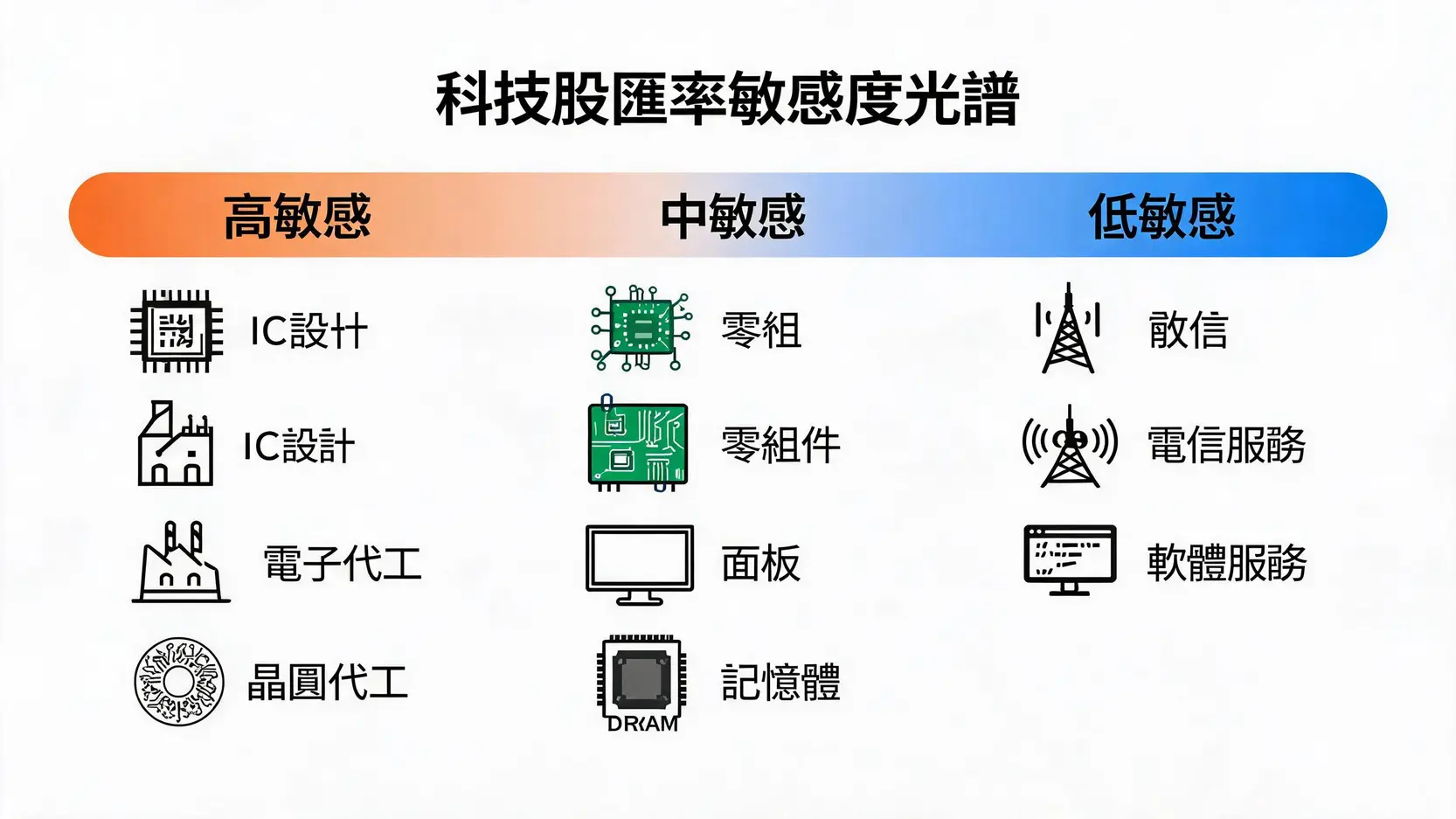
一張圖表將台灣科技股依照匯率敏感度分為高、中、低三個等級,並列出各等級的代表產業。

Taiwan Technology Industry Exchange Rate Sensitivity Spectrum


High-Sensitivity Sectors: Foundries, IC Design, and Electronics Manufacturing (OEM/ODM)

  • Foundries: Representative companies include TSMC and UMC. These companies often purchase equipment from suppliers (such as ASML) using US dollars or euros, while also charging customers in US dollars. However, their significant capital expenditures, local operations, and R&D expenses are largely denominated in Taiwan dollars. As a result, Taiwan dollar appreciation directly reduces revenue when converted back into Taiwan dollars and negatively impacts gross margins. TSMC frequently notes during earnings calls that “every 1% appreciation of the Taiwan dollar reduces gross margin by approximately 0.5 percentage points”. This is a classic example of quantified exchange rate sensitivity.
  • IC Design (Fabless): Representative companies include MediaTek and Realtek. Their costs consist mainly of wafer fabrication expenses paid to foundries (in US dollars) and R&D salaries paid (in Taiwan dollars). While part of their cost base is dollar-denominated, substantial Taiwan dollar personnel expenses make them highly sensitive to exchange rate movements.
  • Electronics Manufacturing (OEM/ODM): Representative companies include Foxconn, Quanta Computer, and Pegatron. This is a typical “3% to 4% gross margin” industry, with extremely thin profit margins. Nearly 100% of their revenue is denominated in US dollars, while labor costs and part of their component costs at production bases are paid in local currencies (Taiwan dollars or Chinese yuan). Even small exchange rate fluctuations can erode a significant portion of their profits, making this sector one of the hardest-hit areas in terms of exchange rate sensitivity.


Medium-Sensitivity Sectors: Components, Panels, and Memory

  • Components: Examples include passive components and printed circuit boards (PCBs). Although these companies receive export revenue in US dollars, many upstream materials (such as copper and resin) are also priced in US dollars. Since both revenue and costs are partly dollar-based, some exchange rate exposure is naturally offset, resulting in moderate sensitivity.
  • Panels and Memory (DRAM): Representative companies include AUO, Innolux, and Nanya Technology. These capital-intensive, cyclical industries share characteristics similar to component manufacturers. Many raw materials are purchased in US dollars, but significant depreciation expenses and local operating costs remain Taiwan dollar-denominated, resulting in moderate exchange rate sensitivity.


Low-Sensitivity Sectors: Domestic-Focused Telecom and Software Services

  • Telecommunications: Such as Chunghwa Telecom and Taiwan Mobile. Their sources of revenue (telephone and internet service fees) and costs (base station construction and employee salaries) are almost entirely denominated in New Taiwan dollars. As a result, exchange rate fluctuations have virtually no impact on their core business profitability, making them a natural safe haven from currency risk.
  • Software Services and System Integration: Representative companies include Syscom and Data Systems Consulting. These businesses mainly serve domestic corporate and government clients, with both revenue and expenses denominated in Taiwan dollars. As a result, exchange rate sensitivity is extremely low.


How to Evaluate a Company’s Exchange Rate Sensitivity

Beyond industry-level analysis, investors can use several methods to assess an individual company’s exposure and risk management capabilities.


Identifying Clues in Financial Statements: Export Regions and Revenue Mix

Public financial statements are the best source of information. Annual reports typically disclose “revenue distribution by geographic region”. If more than 70% of revenue comes from the Americas, Europe, or other overseas markets, and is primarily denominated in US dollars or euros, exchange rate sensitivity is likely high. Notes to the financial statements also disclose foreign currency assets and liabilities. Companies holding substantial US dollar assets may experience foreign exchange losses when the Taiwan dollar appreciates. For newer investors, learning how to read financial statements is essential for uncovering these insights.

Listening to Earnings Calls: How Companies Manage Currency Risk?

Exchange rate impacts are among the most frequently discussed topics during earnings calls. Investors should pay attention to three key areas:

  1. Quantified Earnings Impact: Management often provides specific sensitivity metrics, such as “every NT$0.10 appreciation of the Taiwan dollar reduces gross margin by 0.2 percentage points”.
  2. Hedging Strategy: Does the company use foreign exchange hedging tools such as forward contracts or options? Companies with sophisticated hedging programs can significantly reduce exchange rate risk.
  3. Ability to Pass Through Costs: Does the company have sufficient pricing power to transfer currency-related costs to customers or suppliers? This typically depends on its technological moat and market position.


Sensitivity Analysis in Research Reports

Research reports from brokerages and investment institutions are another valuable source of information. Professional analysts build financial models that estimate the impact of different exchange rate scenarios on revenue, gross profit, and EPS. Although these reports may not always be easily accessible, they often provide highly precise quantitative insights that help investors make more informed decisions.


How Investors Can Use Exchange Rate Sensitivity in Their Investment Strategies

Once you understand exchange rate sensitivity and how to evaluate it, the next step is applying that knowledge in real-world investing. Depending on your outlook for future currency movements, different strategies may be appropriate.

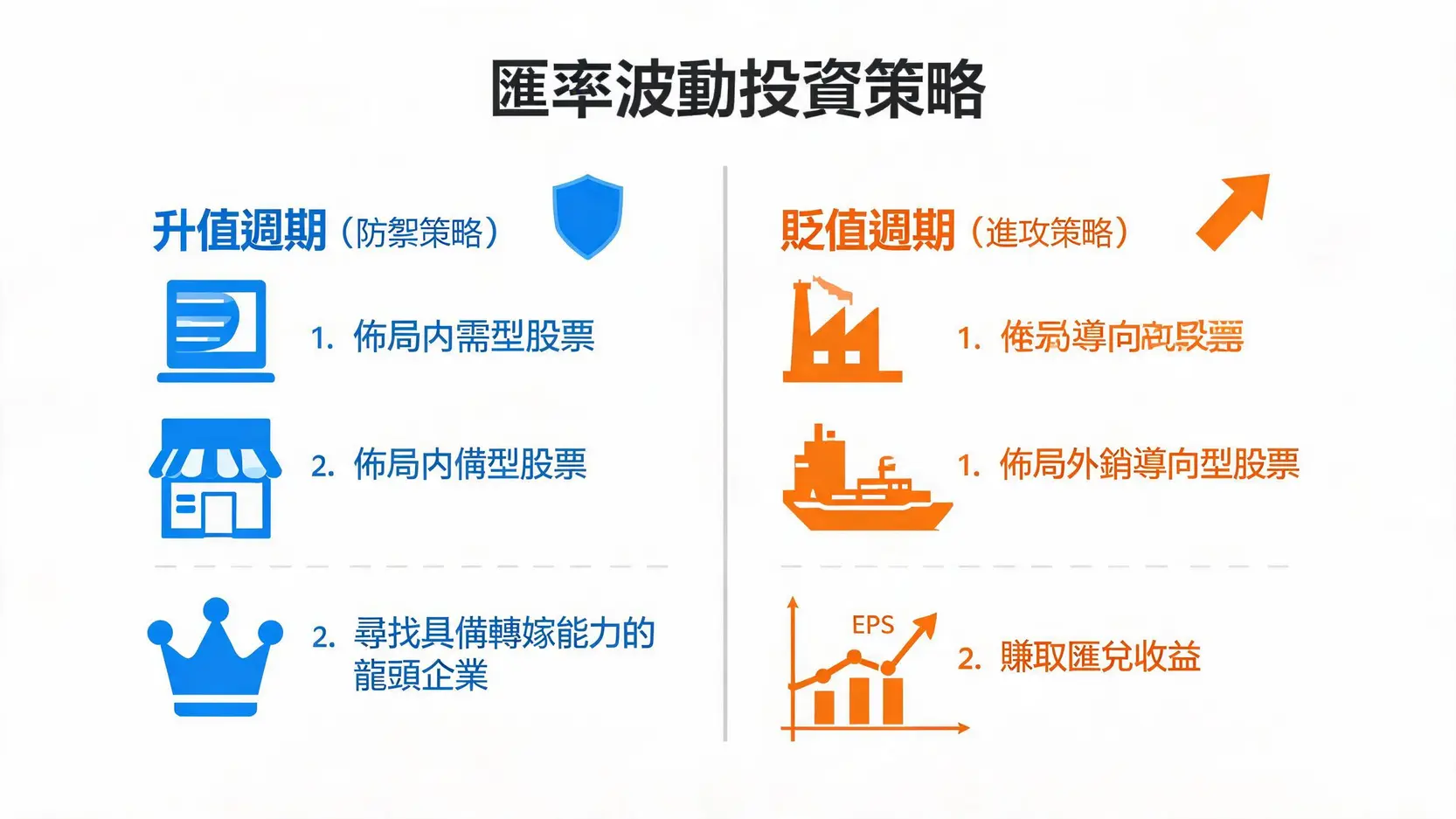
圖表對比新台幣升值與貶值週期下的投資策略,升值期採取防禦策略,貶值期採取進攻策略。

Investment Strategies During Appreciation and Depreciation Cycles


Appreciation Cycle Strategy: Focus on Domestic Businesses and Companies with Pricing Power

If you expect the Taiwan dollar to continue appreciating (for example due to Federal Reserve rate cuts and higher Taiwan interest rates attracting capital inflows), your strategy should emphasize “defense”.

  • Prioritize Low-Sensitivity Sectors: Allocate capital to telecommunications, software, and domestic consumption industries that are largely unaffected by exchange rates.
  • Look for Companies with Pricing Power: Within highly sensitive sectors, focus on market leaders with unique technologies and dominant market share. These companies are often able to raise US dollar prices and pass currency-related costs on to customers, protecting their gross margins.
  • Consider Import Beneficiaries: Taiwan dollar appreciation benefits importers because they can purchase the same products using fewer Taiwan dollars. Industries such as automotive distribution and food ingredient imports may see lower costs and improved profitability.


Depreciation Cycle Strategy: Invest in High-Sensitivity Export Leaders and Capture Foreign Exchange Gain Opportunities

When the New Taiwan dollar is expected to depreciate (for example, due to US interest rate hikes or foreign capital outflows), it becomes a positive catalyst for export-oriented technology stocks. In such an environment, the strategy should shift to an “offensive” approach.

  • Focus on High-Sensitivity Leaders:Actively position in leading companies within highly sensitive sectors such as semiconductor foundries, IC design, and electronics manufacturing services. A weaker Taiwan dollar not only helps companies avoid foreign exchange losses, but may also generate additional “foreign exchange gains”, further enhancing financial results. This is commonly referred to by the market as a “foreign exchange gains rally”.
  • Potential for EPS Upgrades: During depreciation cycles, analysts often revise earnings forecasts upward, creating a positive catalyst for stock prices.


Long-Term Investment Strategy: Choose Companies with Strong Hedging Capabilities and Technological Moats

If you are a long-term value investor rather than an active trader, short-term exchange rate fluctuations should not be your primary concern. Key considerations include:

  • Operational Resilience: Well-managed companies typically maintain sophisticated treasury and risk management departments capable of minimizing exchange rate impacts.
  • Competitive Advantages: Does the company possess irreplaceable technological patents, brand value, or economies of scale? These “economic moats” are the true foundation that enables a company to maintain stable long-term profitability and withstand any external shocks (including exchange rate fluctuations).

For long-term investors, exchange rate-driven share price declines may actually create attractive buying opportunities, allowing them to acquire high-quality businesses at discounted valuations.


Further Reading (Highly Recommended)

S&P 500 Annualized Returns Explained: What Historical Data Can Teach You About Investing in US Equity ETFs…


FAQ

Q: If the Taiwan dollar appreciates, will it be negative for all technology stocks?

A: Not necessarily. While most export-oriented technology companies face pressure from foreign exchange losses when the Taiwan dollar appreciates, companies that rely heavily on imported equipment or critical overseas components may actually benefit from lower import costs. For example, certain semiconductor equipment distributors or companies that import specialized chips may see improved cost efficiency when the Taiwan dollar strengthens. Therefore, the actual impact depends on each company’s business model and cost structure.

Q: How do companies hedge against exchange rate risk? What are the most common tools?

A: Corporate treasury departments typically use a range of financial instruments to manage foreign exchange risk. The most common tools include: 1. Foreign Exchange Forward Contracts (Forwards): Agreements with banks to buy or sell foreign currencies at a predetermined exchange rate on a future date, effectively locking in the exchange rate. 2.Foreign Exchange Options (Options): Contracts that provide the right, but not the obligation, to buy or sell foreign currencies at a specified rate in the future, offering greater flexibility. 3.Natural Hedging: Matching foreign currency revenue with foreign currency expenses whenever possible. For example, establishing overseas manufacturing facilities and using US dollar revenue to pay local operating expenses directly.

Q: Besides technology stocks, which other industries are highly sensitive to exchange rates?

A: Many industries are sensitive to exchange rate movements. For example: 1. Airlines: Aircraft purchases and aviation fuel are both priced in US dollars, making airlines major holders of US dollar liabilities. A stronger Taiwan dollar is generally beneficial for them. 2. Traditional manufacturing industries: Such as textiles, footwear, and machine tools. Like technology stocks, these industries are export-oriented, and a stronger Taiwan dollar can erode profitability. 3. Food and retail industries: If they import large quantities of raw materials (such as soybeans and wheat) or merchandise, a stronger Taiwan dollar can reduce costs. 4. Financial and life insurance industries: If they hold substantial overseas assets (such as investments in US Treasury bonds), exchange rate fluctuations can directly affect the value of those assets.

Q: What is the relationship between exchange rates and interest rates? Why does a US rate hike affect the Taiwan dollar?

A: Interest rates are one of the most important drivers of exchange rates. Capital generally flows toward markets offering higher returns. When the US Federal Reserve raises interest rates, US dollar deposits become more attractive, encouraging global capital to move into the United States. This increases demand for US dollars, causing the US dollar to appreciate and potentially leading to Taiwan dollar depreciation. Conversely, if the Federal Reserve cuts rates while Taiwan raises rates, capital may flow into Taiwan in search of higher returns, supporting Taiwan dollar appreciation. This reflects the fundamental mechanism of global capital movement.

Conclusion

Exchange rate sensitivity is an essential factor when evaluating the investment value of Taiwan technology stocks. It is not merely an accounting item in a financial statement, but a lens through which investors can assess a company’s cost management capabilities, pricing power, and operational resilience. Understanding how exchange rates affect gross margins, recognizing the varying levels of sensitivity across industries, and learning how to identify key indicators in financial reports and earnings calls can help investors gain deeper insight into a company’s true operating performance.

Ultimately, investors should avoid making investment decisions solely based on short-term currency movements. A more effective approach is to treat exchange rate sensitivity as one component of a broader evaluation framework, combining it with industry trends, company fundamentals, and long-term competitive advantages. By doing so, investors can make more informed and resilient decisions in an increasingly complex financial environment.

编者
Evan Lin

Evan Lin

我是Evan Lin,从大学时期开始接触外汇交易,至今已有多年实战经验,熟悉技术分析与EA策略,热衷于研究市场脉动与风险管控,喜欢分享实战经验和交易技巧,和大家一起学习、一起进步!

If you liked this article, please share it!

Related Articles

  • 2026 Yen Forecast: Exchange Strategy for H2 2026
    [Second Half of 2026] Complete Japanese Yen Outlook Forecast: The Ultimate Currency Exchange Strategy for Investors and Travelers Following record-breaking market interventions, the future outlook for the Japanese yen is filled with both uncertainty and opportunity. Will the yen regain its strength, or will it fall to new lows? This...
    2026 年 6 月 5 日
  • Taiwan Stocks & Geopolitical Risk Premium Explained
    How Significant Is the Impact of the Geopolitical Risk Premium on Taiwan Stocks? Understanding the Risks, Opportunities, and Investment Strategies In an increasingly globalized world, Taiwan's stock market is influenced not only by economic fundamentals but is also constantly exposed to complex geopolitical risks. From tensions in cross-strait relations to...
    2026 年 6 月 5 日
  • Foreign Investors Buy NT$62.7B: Stocks & FX Signals
    The Fourth Largest Net Buy in History! Foreign Investors Snap Up NT$62.7 Billion of Taiwan Stocks, Revealing Three Key Signals Behind Stocks and the Currency Rising in Tandem Taiwan's stock market staged a stunning rally, surging more than 900 points in a single day with trading volume reaching extraordinary levels....
    2026 年 6 月 5 日
返回顶部