Guide to Online Foreign Currency Exchange and Telegraphic Transfer (T/T): Understand the Meaning, Fees, and Practical English in One Article
Whether you are traveling abroad, shopping online overseas, or handling international trade payments, you will often encounter terms such as “online foreign currency exchange” and “telegraphic transfer (T/T)”. But do you truly understand the meaning of online foreign currency exchange? Do you know what telegraphic transfer (T/T) is and how it works behind the scenes? Many people unknowingly pay extra fees or encounter communication difficulties because they are unfamiliar with these concepts. This article provides a one-stop ultimate guide, covering basic concepts, practical operating steps, and essential English vocabulary for foreign currency exchange, helping you master all key knowledge easily, become skilled in foreign exchange, and save both money and time.
Complete Explanation of Online Foreign Currency Exchange: Meaning, Advantages, and Key Considerations
With the development of financial technology, exchanging foreign currency is no longer limited to visiting a bank or money changer in person. Online foreign currency exchange has become the preferred choice for many people due to its convenience. The following section explores its definition, advantages, and operating procedures in detail.
What Is an “Online Foreign Currency Exchange”? How Is It Different From Traditional Money Changers?
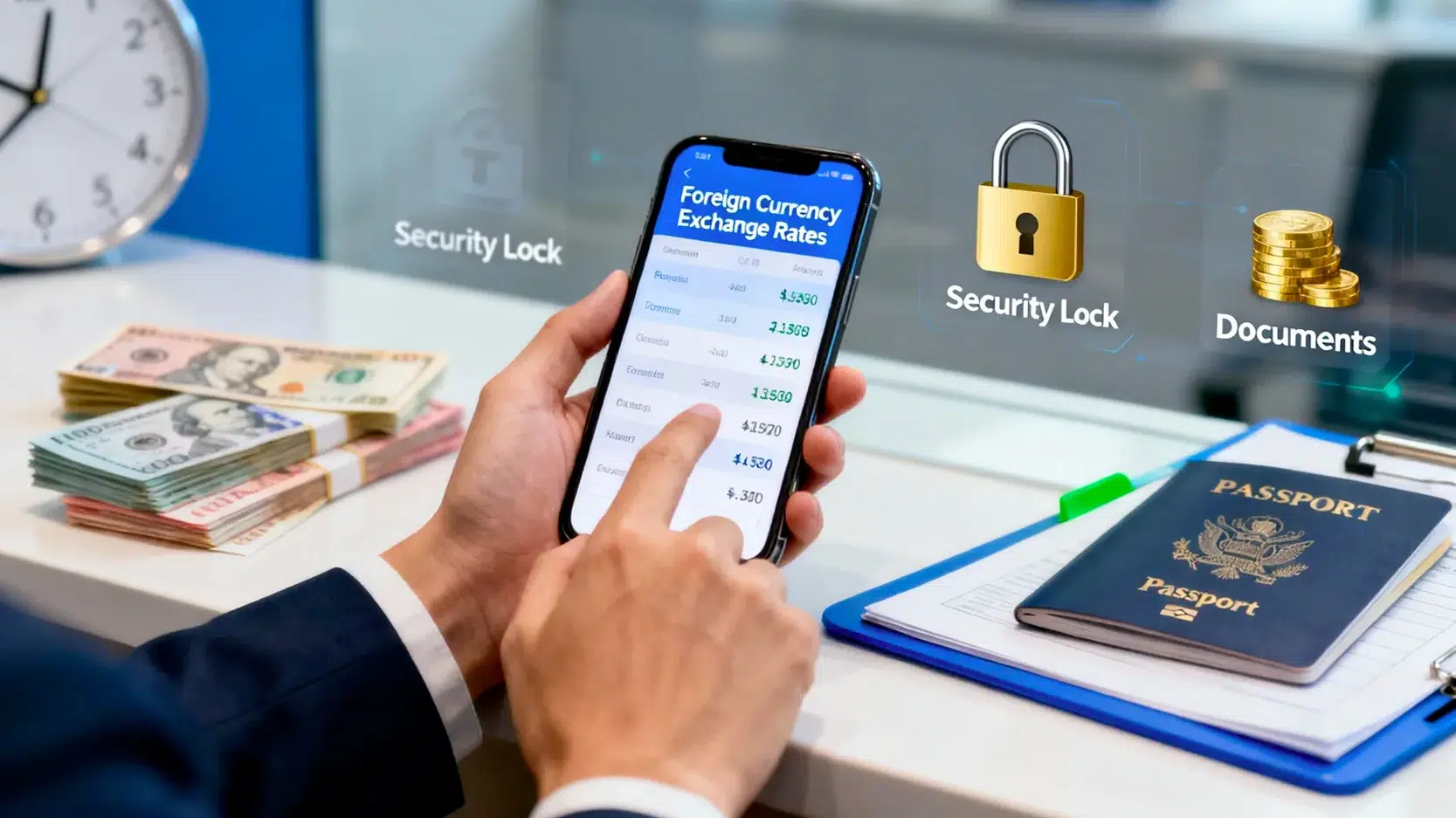
“Online foreign currency exchange” refers to converting one currency into another directly within your own bank account through an online platform provided by a bank or financial institution (such as a mobile App or website). The entire process does not involve physical banknotes, and transaction records are clear and traceable.
The biggest differences compared with traditional money changers include:
- Transaction medium: Online exchange is a digital conversion within an account, while money changers deal with physical cash transactions.
- Exchange rates used: Online exchange usually uses the “Spot Rate”, while money changers use the “Cash Rate”. Generally speaking, since banks incur storage and transportation costs for physical cash, the spot rate is usually more favorable than the cash rate. You may refer to Chang Hwa Bank Foreign Exchange Guide: Exchange Rate Inquiry, Currency Exchange, and Withdrawal Explained to learn more about exchange rate knowledge.
- Time and location: Online exchange is not restricted by time or location, while money changers have fixed business hours and locations.
Three Major Advantages of Online Currency Exchange: Better Rates, Convenience, and 24-Hour Access
Choosing online foreign currency exchange mainly offers the following three benefits:
- Better exchange rates: As mentioned earlier, online exchange generally uses the spot rate, allowing your funds to achieve better value.
- Convenient and efficient: Only a few simple steps are required to complete the transaction on your phone or computer, eliminating the need to wait in line.
- Available at all times: Most online platforms provide 24/7 services, allowing you to capture favorable exchange opportunities based on market fluctuations even outside banking hours.
Step-by-Step Tutorial: How to Complete Currency Exchange Easily in a Bank App or Platform
Although the App interfaces of different banks vary slightly, the basic process is generally similar:
- Log in to your account: Open your bank mobile App or online banking platform and log in.
- Find the foreign exchange function: In the main menu you will usually find options such as “Foreign Currency Exchange”, “Currency Exchange”, or “FX Exchange”.
- Select currency and account: Choose the currency you want to sell and the currency you want to buy, and specify the account for deduction and deposit.
- Enter the amount: Enter the amount you wish to exchange, and the system will instantly display the estimated exchange rate and the converted amount.
- Confirm the transaction: Carefully review all information, including the exchange rate, amount, and fees (most personal exchanges do not charge a handling fee). After confirming that everything is correct, proceed with the transaction.
Understanding an International Trade Keyword: What Is Telegraphic Transfer (T/T)?
When large sums of money or international commercial payments are involved, the term “telegraphic transfer” or “T/T” is often mentioned. This section explains the standard method used for international remittances.
Understanding the True Meaning of “Telegraphic Transfer (T/T)”
Telegraphic Transfer (T/T) is a traditional international remittance method. It refers to the sending bank transmitting payment instructions to the receiving bank through telecommunication systems or the SWIFT network in order to complete the transfer of funds. Simply put, it is a standardized cross-border bank transfer process.
Because of its security, reliability, and official transaction records, telegraphic transfer is widely used for international trade payments, overseas investments, tuition payments, and other large or important fund transfers.
The Complete Telegraphic Transfer Process: How Long Does It Take From Sender to Receiver?
A telegraphic transfer usually involves the following major steps, which is why it cannot be credited instantly:
- Submission by the sender: The remitter submits a telegraphic transfer application at the bank, providing detailed information about the recipient (including name, address, bank account number, bank name, and SWIFT code).
- Processing by the sending bank: After verifying the information, the sending bank issues payment instructions to the receiving bank through the SWIFT system.
- Intermediary bank (if applicable): If the two banks do not have a direct relationship, the funds may pass through one or more “intermediary banks” for transfer.
- Credit by the receiving bank: After receiving the instructions and funds, the receiving bank verifies the details and deposits the money into the recipient’s account.
The entire process usually takes 1 to 5 business days. The exact duration depends on the countries involved, the processing efficiency of the banks, and whether intermediary banks are required.
Telegraphic Transfer Fee Structure: Understanding Sending Bank, Intermediary Bank, and Receiving Bank Charges in One View
The fee structure of telegraphic transfers is relatively complex. Understanding it clearly helps prevent your transferred amount from “being reduced” unexpectedly. The fees mainly include the following components:
| Fee Type |
Description |
Charging Party |
| Sending Bank Fee |
Charged by the bank initiating the transfer, and the fee is relatively fixed. |
Sending Bank |
| Intermediary Bank Fee |
If the remittance requires an intermediary bank, it will deduct a processing fee from the principal amount. This is the most common “hidden cost”. |
Intermediary Bank |
| Receiving Bank Fee |
Some receiving banks charge a fee for incoming overseas funds. |
Receiving Bank |
| Exchange Rate Spread |
The telegraphic transfer exchange rate provided by banks usually includes a spread, which is also one of the bank’s sources of profit. |
Sending Bank |
Money-Saving Tip: When arranging a telegraphic transfer, you can ask the bank whether it offers a “full amount credited” service. This usually requires paying an additional fee, but it ensures that the recipient receives the full amount and avoids discrepancies caused by intermediary bank charges.
Further Reading (Highly Recommended)
2026 Beginner’s Guide to Forex Trading: Master Risk Management and Broker Selection for Stable Profits!
2026 Latest! Complete Guide to International Remittance Fees: Comparison of Charges From 5 Major Banks and a Pitfall Avoidance Guide
Practical Foreign Currency Exchange English Classroom: Smooth Communication for Travel and Business
Mastering some basic foreign currency exchange English vocabulary and conversations can help you communicate more smoothly and demonstrate professionalism, whether you are traveling abroad or handling business remittances.
Core Vocabulary Comparison Table (Foreign Currency Exchange Vocabulary)
| English Term |
Chinese Translation |
Brief Explanation |
| Foreign Currency Exchange |
Foreign Currency Exchange |
The act of converting one currency into another currency.
|
| Exchange Rate |
Exchange Rate |
The conversion ratio between two currencies. |
| Spot Rate |
Spot Rate |
Usually refers to the exchange rate used for electronic transactions and does not involve physical banknotes. |
| Cash Rate / Banknote Rate |
Cash Rate |
The exchange rate used when buying or selling physical foreign currency banknotes. |
| Buy Rate / We Buy |
Buying Rate |
The rate at which a bank or money changer “buys” foreign currency from you. |
| Sell Rate / We Sell |
Selling Rate |
The rate at which a bank or money changer “sells” foreign currency to you. |
| Commission / Service Charge |
Handling Fee / Service Fee |
The fee that may be charged when carrying out currency exchange or remittance. |
| Telegraphic Transfer (T/T) |
Telegraphic Transfer |
A method of international bank transfer. |
| Remitter |
Remitter |
The party initiates the remittance. |
| Beneficiary |
Beneficiary |
The party receiving the funds. |
| SWIFT Code / BIC |
Bank International Code |
A unique code used to identify a bank in international remittances. |
Scenario Dialogue: How to Exchange Foreign Currency in English at a Bank or Money Changer?
Below is a simulated practical conversation for exchanging cash at an overseas bank:
You:
“Hi, I’d like to exchange some US dollars for Japanese Yen, please.”
(Hello, I would like to exchange some US dollars for Japanese Yen.)
Bank Teller:
“Certainly. What’s the exchange rate today?”
(Alright. What is today’s exchange rate?)
You:
“The sell rate for Japanese Yen is 145.50.”
(The selling rate for Japanese Yen is 145.50.)
Bank Teller:
“Okay. How much would you like to exchange?”
(Alright. How much would you like to exchange?)
You:
“I’d like to exchange 500 US dollars.”
(I would like to exchange 500 US dollars.)
Bank Teller:
“Alright. Is there any service charge?”
(Alright. Is there any service charge?)
You:
“No, there’s no commission. So, that will be 72,750 Japanese Yen. How would you like the cash?”
(No, there is no commission. The total will be 72,750 Japanese Yen. What denominations would you like?)
FAQ
Q: Does online foreign currency exchange use the “Spot Rate” or the “Cash Rate”?
A: In most cases, online foreign currency exchange uses the “Spot Rate”. This is because the transaction does not involve handling physical banknotes. Banks save costs related to transportation, storage, and counting of cash, allowing them to offer a more favorable rate than the “Cash Rate”. This is also one of the main reasons why online exchange is usually more cost-effective than exchanging cash at a counter.
Q: What is the difference between Telegraphic Transfer (T/T) and a normal transfer?
A: The main differences lie in “geography” and “system”. A normal transfer (Local Transfer) usually refers to a domestic bank transfer within the same country or region, which is faster and has lower fees. Telegraphic Transfer (T/T), on the other hand, is an international remittance method designed for cross-border bank transfers. It operates through the SWIFT network, involves a longer process, and generally has higher fees.
Q: How can I correctly fill out a Telegraphic Transfer (T/T) form?
A: Accuracy is extremely important when completing a T/T form. Be sure to carefully verify the following key information:
1. Beneficiary’s Full Name: Must exactly match the name on the recipient’s bank account.
2. Beneficiary’s Address: The full address written in English.
3. Account Number / IBAN: IBAN format is commonly used in Europe.
4. Beneficiary Bank’s Name & Address: Must be clearly and accurately written.
5. SWIFT Code / BIC: This functions as the “bank address” in international remittances and must not be incorrect.
Q: Can the Telegraphic Transfer fee be paid by the recipient?
A: Yes. When submitting a Telegraphic Transfer request, there are usually several options for who bears the fees. The most common options include:
- OUR: All fees (including those from the sending bank, intermediary bank, and receiving bank) are paid by the remitter, ensuring the beneficiary receives the full amount.
- BEN: All fees are paid by the “beneficiary”, and the bank will deduct the relevant fees from the remittance amount.
- SHA: The fees are shared by both “parties”. The remitter pays the sending bank’s fee, while the remaining fees are borne by the beneficiary.
In commercial transactions, the payment terms usually specify which method will be used.
Conclusion
In summary, online foreign currency exchange provides great convenience and cost advantages for individuals with small and frequent currency exchange needs, making it the preferred option for overseas travel or small payments. Meanwhile, Telegraphic Transfer (T/T), with its security and standardized process, remains an indispensable tool for serious scenarios such as commercial trade and large fund transfers. By understanding the basic meanings, operational processes, and fee structures of both methods, and by mastering key foreign currency exchange English terms, you can handle any foreign exchange needs with greater confidence and efficiency while making the most cost-effective decisions.