MD5 Encryption Guide: How It Works vs SHA256

Updated: 2026/03/11  |  CashbackIsland

md5-encryption-decryption-guide

Ultimate Guide to MD5 Encryption and Decryption: Understand MD5 Principles, Security, and Comparison With SHA256 in One Article

Have you often heard the term MD5 encryption but are not sure what it actually is? Or are you worried whether the MD5 encryption used by your website or application is still secure? In an era of information overload, data security is critically important. This article will guide you step by step, from understanding MD5 principles and encryption applications to uncovering the truth behind so-called “MD5 decryption”. It will also provide a complete comparison with the new generation standard SHA256 comparison, allowing you to fully grasp the core concepts of information security and ensure your digital assets remain well protected. 


What Is MD5 Encryption? Understanding the Core Principle in Seconds

First, we need to clarify a common misconception. Many people refer to it as “MD5 encryption”, but this description is actually inaccurate. Let us examine the true nature of MD5.


The True Identity of MD5: It Is Not Encryption, but a “Hash Function”

The full name of MD5 is Message-Digest Algorithm 5. It is not an encryption algorithm, but a hash function. What is the fundamental difference between the two?

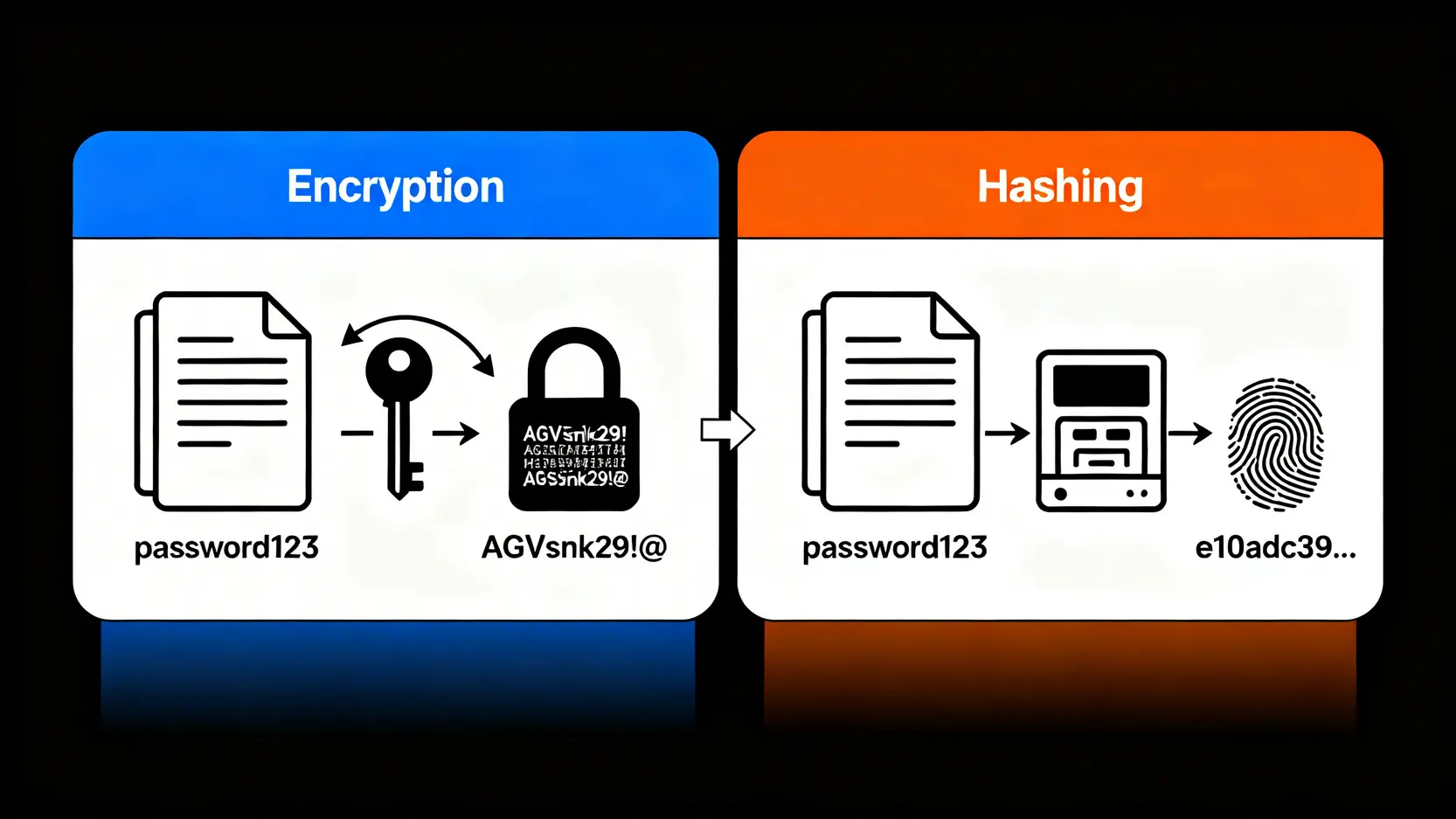
  • Encryption: This is a reversible process. You can encrypt plaintext, such as password123, into ciphertext (such as “AGVsnk29!@”) using a key. The ciphertext can later be decrypted with the corresponding key to restore the original plaintext. It is similar to locking a box, where anyone with the key can open it.
  • Hashing: This is a one-way and irreversible process. It converts data of any length into a fixed-length string of characters using a specific algorithm. This string is known as a “hash value” or “digital fingerprint”. It is impossible to reverse the hash value to obtain the original data. It is like putting fruit into a blender. You can easily turn an apple into apple juice, but you can never restore apple juice back into a whole apple.

加密與雜湊的比較圖,顯示加密是可逆的過程,而雜湊是單向不可逆的過程。

Encryption vs Hashing: One is a reversible safe, while the other is a one-way processing mechanism.

Therefore, the correct definition of MD5 is a tool that generates a unique “digital fingerprint” for any data, rather than a lock used to encrypt and protect data.


How MD5 Works: Converting Any Data Into a 128-Bit Unique Fingerprint

The MD5 process is quite sophisticated. It can convert any file or text of any size, whether it is a movie, an image, or a simple sentence, into a string composed of 32 hexadecimal characters with a total length of 128 bits.

This process has several key characteristics:

  • Fixed length: Regardless of the size of the original data, the output MD5 hash value is always 128 bits.
  • High sensitivity (also known as the avalanche effect): Even the smallest change in the original data, such as a single letter or space, will produce a completely different MD5 value.
  • Deterministic: The same data will always produce the same hash value whenever MD5 is calculated.

For example:

Original text: “Hello World” → MD5 value: “b10a8db164e0754105b7a99be72e3fe5”

Original text: “hello World” (only the lowercase h changes) → MD5 value: “d7b7a58c0378fa630807a68551a37397”

Because of these characteristics, MD5 was widely used in the early days for file verification, (ensuring downloaded files remain intact), and for password storage.


Recommended Further Reading

2025 Blockchain Application Guide: 10 Real-World Cryptocurrency and Ethereum Use Cases


Is MD5 Decryption Possible? The Truth Behind Cracking Hash Values

Since MD5 is a one-way irreversible function, why are there so many “MD5 decryption tools” available online? This is actually a clever misconception. These tools do not truly “decrypt” MD5 hashes. Instead, they attempt to find the original data that generated the hash using other methods.


Why MD5 Is a One-Way Function and Cannot Be Reversed

During the calculation process, the MD5 algorithm performs multiple complex and irreversible mathematical operations on the original data, such as bitwise operations and modular additions. In this process, a large amount of the original information is effectively “lost”, similar to the blender example mentioned earlier. From a mathematical perspective, it is impossible to reconstruct the original input from a 128-bit output with potentially infinite possibilities.


Common Cracking Methods: Dictionary Attacks, Brute-Force Attacks, and Rainbow Tables

So-called “MD5 decryption” websites actually rely on comparison against a massive database. They have not cracked the algorithm itself, but instead use several common “cracking” methods as follows:

  • Dictionary attack: Hackers create a “dictionary” containing common words, phrases, and password combinations. They compute the MD5 hash for each entry and store them in a massive database. When a target MD5 value appears, they simply search the database for a matching hash. If your password is “password” or “123456”, it can be cracked almost instantly.
  • Brute-force attack: This is a more primitive but effective method. Hackers attempt every possible character combination (such as “aaa”, “aab”, “aac” and so on), calculating the MD5 value for each and comparing it with the target hash. Although time-consuming, it remains effective against short and simple passwords.
  • Rainbow Tables: This is an advanced version of a dictionary attack and represents a space-time trade-off strategy. Instead of directly storing a mapping table of plaintext and hash values, it stores a series of “chains” generated through multiple hashing operations and specific “reduction functions”. This greatly reduces storage space while still allowing the possible original plaintext to be quickly retrieved from a hash value. Many online MD5 decryption tools are based on rainbow table technology.

After understanding these methods, you will realize that the security of MD5 depends heavily on the complexity of the original data. If the plaintext is a simple password, the risk of it being “cracked” through the methods mentioned above becomes extremely high. Therefore, adopting more secure strategies for user password creation is critically important.


MD5 vs SHA256: The Ultimate Comparison Between Old and New Hash Algorithms

As computing power has increased dramatically, weaknesses in MD5 have become more apparent. The most critical vulnerability is known as a “collision attack”. This has led to the widespread adoption of more secure hash algorithms such as SHA-256.


Security Comparison: Why MD5 Is No Longer Secure? An Analysis of the Fatal Weakness of “Collision Attacks”

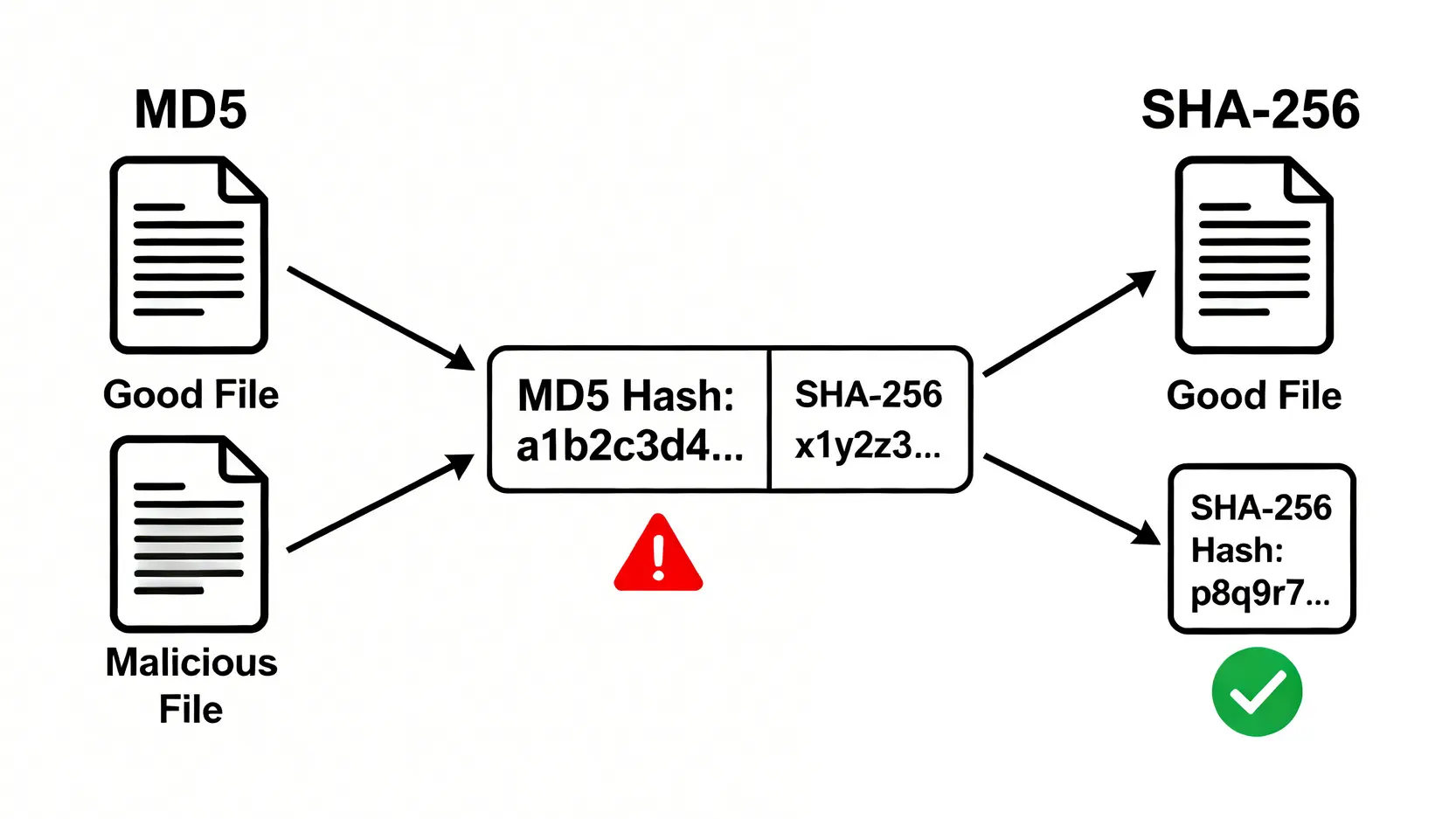
The most critical flaw of MD5 is the possibility of “collisions”. A collision occurs when two completely different pieces of data produce the same MD5 hash value. This is equivalent to two different individuals having exactly the same fingerprint, which would be disastrous for authentication systems.

MD5與SHA-256的碰撞攻擊風險比較圖,顯示兩個不同文件可能產生相同MD5值,但會產生不同的SHA-256值。

The fatal weakness of MD5: Different files (such as a legitimate contract and a malicious program) may produce identical “fingerprints”, leading to serious security vulnerabilities.

As early as 2004, a research team led by Professor Wang Xiaoyun at Shandong University published a method for quickly finding MD5 collisions, shocking the global cryptography community. This means that malicious attackers can create a malicious file with different content from a legitimate file but with the same MD5 value. If you rely solely on MD5 to verify file integrity, you may unknowingly download and execute malicious software. For more technical details about collision attacks, you can refer to the explanation on Wikipedia.

In contrast, SHA-256 (Secure Hash Algorithm 256-bit) generates longer hash values and uses a more complex algorithm. Currently, no practical collision attacks have been discovered against SHA-256, making it significantly more secure than MD5.


Length and Performance Comparison: Key Differences Between MD5 and SHA256

To make the differences clearer, the following comparison table highlights the main distinctions between MD5 and SHA256.

Feature

MD5

SHA-256
Output Length 128 bits (32 hexadecimal characters) 256 bits (64 hexadecimal characters)
Security Low (collision vulnerabilities have been proven) High (currently considered secure)
Computation Speed Fast Relatively slower
Collision Attack Risk High (practically feasible) Extremely low (theoretically possible, but not currently achievable)


Application Scenario Recommendations: When Should You Use MD5, and When Must You Choose SHA256?

After understanding the differences between the two, you can make informed decisions:

  • Applicable Scenarios for MD5 (Non-Security Requirements):

    • File integrity verification: When downloading software or files, the MD5 value provided by the website can be used to quickly verify whether the file was damaged or corrupted during transmission. Although MD5 has weaknesses, deliberately creating a different file with the same MD5 value still requires effort. Therefore, it remains convenient and practical for non-high-security scenarios.
    • Data deduplication: In cloud storage or databases, MD5 values can be calculated to determine whether duplicate files already exist, helping reduce storage space.
  • Scenarios That Must Use SHA-256 or Stronger Algorithms (Security Requirements):
    • User password storage: Never use MD5 to store passwords! At a minimum, SHA-256 should be used, combined with “salting” to defend against dictionary attacks and rainbow tables.
    • Digital signatures and certificates: SSL/TLS certificates and software signatures must use SHA-256 or stronger algorithms to ensure authenticity and prevent forgery.
    • Blockchain technology: Cryptocurrencies such as Bitcoin rely on SHA-256 as the foundation of their blockchain architecture, using its strong security properties to guarantee that transactions cannot be tampered with. If you are interested in blockchain, you can read the 2025 Blockchain Application Guide to learn more.


MD5 Frequently Asked Questions (FAQ)

Q: Can MD5 be successfully decrypted?

A: Strictly speaking, it cannot. MD5 is a one-way hash function and cannot be mathematically reversed or “decrypted”. However, if the original data, such as a simple password, exists in a hacker’s database built through methods such as dictionary attacks or rainbow tables, the plaintext can be easily “looked up”, resulting in it effectively being “cracked”.

Q: What is the biggest difference between MD5 and SHA-256?

A: The biggest difference lies in security and output length. SHA-256 generates a 256-bit hash value, which is significantly longer than MD5’s 128-bit output. This allows SHA-256 to resist collision attacks and provides much stronger security. In simple terms, SHA-256 is the modern security standard, while MD5 has been phased out from security-critical applications due to known vulnerabilities.

Q: Can MD5 still be used to store user passwords today?

A: Absolutely not! This is extremely dangerous. Due to MD5’s collision vulnerabilities and the widespread use of rainbow tables, passwords stored using MD5 can be cracked easily. The current industry standard is to use stronger hash algorithms such as SHA-256, bcrypt, or Argon2, and they must always be combined with “salting”.

Q: What is “Salting”, and does it make MD5 secure?

A: “Salting” refers to adding a randomly generated and unique string (known as a “salt”), to each password before performing the hash calculation. This means that even if two users have the same password, their stored hash values will be different because their “salts” differ. This effectively defends against rainbow table attacks. However, salting cannot fix MD5’s inherent collision weaknesses. The correct approach is to “salt secure algorithms (such as SHA-256)”, rather than trying to make MD5 secure through salting.


Conclusion

In summary, MD5 as a fast hash algorithm still has practical value in non-security scenarios such as file integrity verification. However, when it comes to password storage, digital signatures, or any security application that requires data authenticity, its known collision vulnerabilities make it an unreliable choice. By understanding MD5 principles and comparing MD5 with SHA256, developers and system administrators should prioritize SHA-256 or stronger algorithms. This is a fundamental requirement for protecting data security. It is time to review your systems and upgrade to stronger encryption standards!

If you liked this article, please share it!

Related Articles

  • How to Buy Bitcoin in 2026: A Beginner’s Guide
    How to Get Started with Bitcoin? The Complete 2026 Bitcoin Buying Guide for Beginners After watching Bitcoin repeatedly reach new highs in recent years and successfully pass spot ETF reviews in the US and Hong Kong in 2024, officially entering mainstream financial markets, many investors have turned their attention to...
    2026 年 7 月 20 日
  • Gold V-Shaped Rebound: Bottom Signal or Bull Trap?
    Is Gold’s V-Shaped Rebound a Bottom-Fishing Signal? A Complete Guide to Trading Strategies Amid “$100 Price Swings” What Is a Gold V-Shaped Rebound? More Than Just a Technical Pattern The gold market has recently experienced sharp rises and falls, with prices frequently displaying dramatic “gold V-shaped rebounds”. Single-day “$100 price...
    2026 年 7 月 20 日
  • 2026 PPI Guide: PPI vs CPI and Stock Market Impact
    What Is PPI Data? 2026 Latest Analysis: Understand the Differences from CPI and How It Affects Stock Market Trends With market information constantly changing, do you always hold your breath while waiting for CPI data to be released? But did you know that a more forward-looking inflation indicator, PPI data...
    2026 年 7 月 20 日
返回顶部