Futures Intraday Trading: 5 Beginner Strategies

Futures Intraday Fresh Tutorial: 5 Essential Day Trading Short-Term Strategies That Beginners Can Quickly Master!
Seeing daily market fluctuations and wanting to profit quickly through Futures Intraday Trading (Day Trade), but worried about high risk and not knowing where to start? Many beginner investors face the same confusion. This complete Futures Intraday Fresh Tutorial will provide an in-depth breakdown of core Day Trade futures techniques, from basic concepts to 5 practical short-term futures strategies, helping you build a solid trading foundation, effectively control risk, and capture opportunities in the market.
Building the Foundation: What Is Futures Intraday Trading (Day Trade)?
Futures Intraday Trading, also known as Day Trade, refers to a trading model where buying and selling are completed within the same trading day, meaning positions are not held overnight. The core of this trading approach is to take advantage of short-term intraday price fluctuations to earn price differences and pursue fast capital returns.
Definition of Intraday Trading: Why Is Short-Term Futures Trading a High-Risk, High-Return Game?
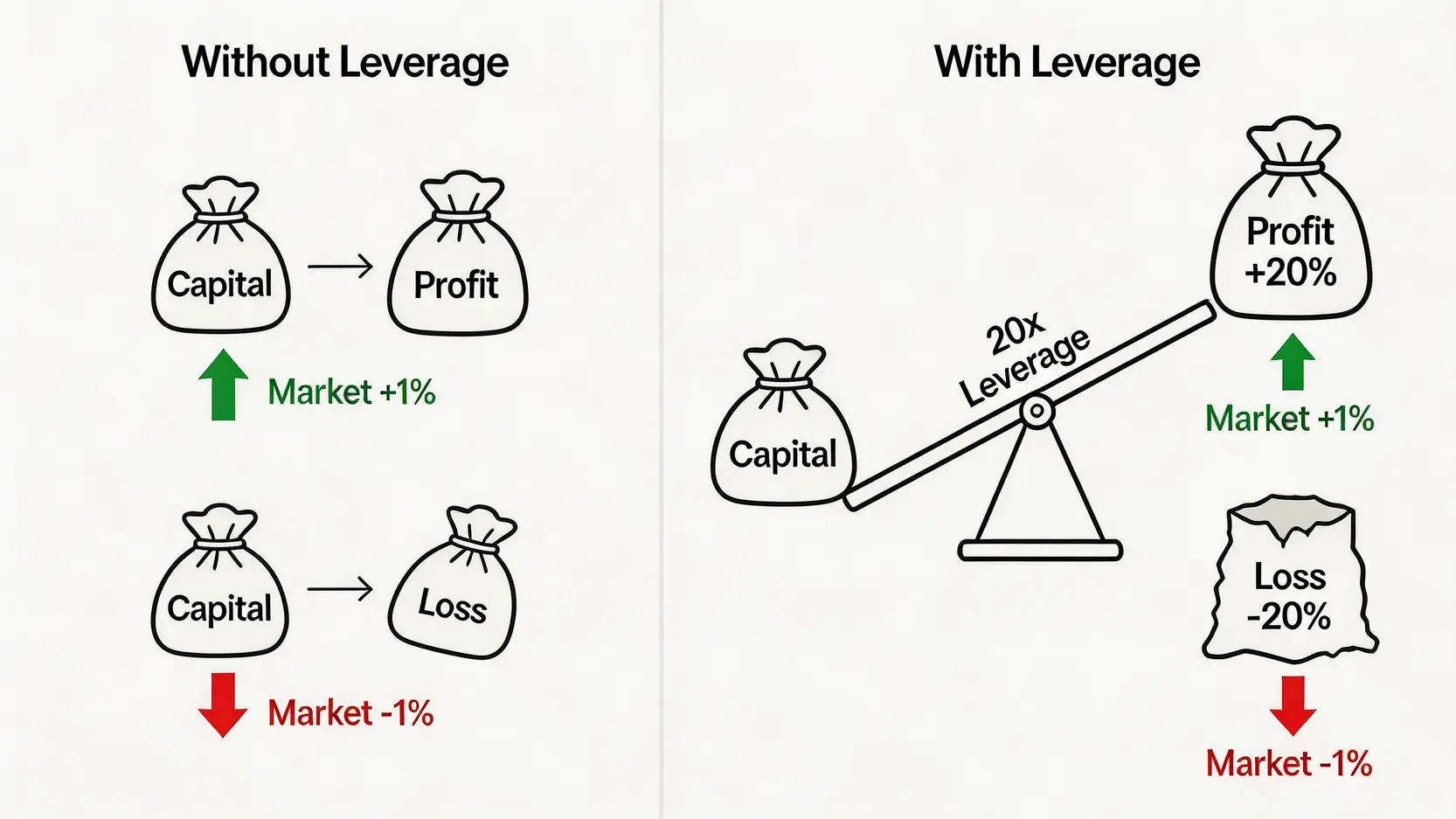
Short-term futures trading is considered high risk and high return mainly due to its “leverage effect”. Futures trading uses a margin system, where traders only need to deposit a small portion of the contract value (margin) to control a contract worth much more than the margin itself. For example, with 20x leverage, a 1% market movement can result in a 20% gain or loss in your capital. This means:
- Amplified Profits: When the market moves in your favor, profits are significantly magnified by leverage, which is also what makes Day Trade attractive.
- Amplified Losses: When the market moves against you, losses are also magnified, potentially eroding a large portion of your capital in a short time.

Illustration of leverage effect: Small market movements lead to simultaneous amplification of both profit and risk.
Therefore, Day Trade is like a precise game of strategy. Traders must possess accurate judgment and strict discipline in order to harness its high-return potential while controlling the associated significant risks.
Pros and Cons Analysis: Understanding the Potential Profits and Challenges of Intraday Trading
Before entering the world of short-term futures trading, it is essential to objectively evaluate its advantages and disadvantages.
| Advantages |
Disadvantages |
| Avoid overnight risk: Close positions before the market closes, so there is no need to worry about major international events occurring overnight affecting the next day’s opening. |
Extremely high psychological pressure: Market conditions change rapidly, requiring quick decision-making, which can easily lead to anxiety and emotional trading. |
| High capital turnover: Funds are settled on the same day and can be reused repeatedly, improving capital efficiency. | Accumulated trading costs: Frequent entries and exits can generate significant fees and transaction costs, eroding profits. |
| Focus on intraday movements: Traders only need to focus on analyzing the day’s price action without spending significant effort on long-term fundamentals. | Requires high level of focus: Day Trade demands that traders dedicate a large amount of time and attention during market hours, making it unsuitable for those who cannot constantly monitor the market. |
| High potential returns: By using leverage, even small market fluctuations can generate substantial profits. | Prone to overtrading: After losses, traders may rush to recover, or after profits, become overconfident, both of which can lead to irrational and excessive trading. |
Beginner Preparation: 3 Key Steps Before Starting Day Trade Short-Term Futures
As the saying goes, “To do a good job, one must first sharpen one’s tools”. A successful Day Trader must never neglect preparation. Below are the three key steps before entering the market.
Step 1: Choosing the Right Futures Contract
Not all futures are suitable for short-term trading. An ideal Day Trade instrument should have the following characteristics:
- High liquidity: Large trading volume and small bid-ask spreads ensure your orders can be executed at ideal prices at any time, avoiding situations where you “cannot buy or sell when needed”.
- High volatility: Price movements within the day are large enough to create profitable opportunities.
For investors in the Asia-Pacific region, the following are popular choices:
- Hang Seng Index Futures (HSI Futures): Commonly known as the “big HSI”, it represents Hong Kong blue-chip stocks. It has extremely high trading volume and strong volatility.
- Mini Hang Seng Index Futures (Mini-HSI Futures): Commonly known as the “mini HSI”, its contract size is one-fifth of the “big HSI”, with lower margin requirements, making it more suitable for beginners.
Second Step: Key Considerations for Choosing a Trading Platform and Charting Software
A stable and fast trading platform is the lifeline of a Day Trader. When choosing, you should focus on the following:
- Order execution speed and stability: Even milliseconds can affect execution price. The system must never delay or crash at critical moments.
- Reasonable trading costs: Fees accumulate over time and become a significant cost, especially for short-term traders. You should choose brokers with transparent pricing and competitive rates.
- Powerful charting features: Real-time quotes, multiple technical indicators, and drawing tools are essential weapons for market analysis.
- Intuitive interface: The interface should be clear and easy to understand, allowing you to quickly execute buy and sell orders and set stop-loss levels.
When making a choice, you can compare multiple options to find the tool that best matches your trading style. You may refer to Futures Trading App Recommendations: 5 Apps Favored by Experts (Fees/ Stability/ Download) to understand the strengths and weaknesses of mainstream platforms in the market.
Further Reading (Highly Recommended)
CFD Trading Strategies: 2026 Complete Guide to CFDs, Avoid 7 Critical Risks!
Step 3: Set Initial Capital and Risk Management Bottom Line
Before investing real money, you must establish a clear capital and risk management plan. This is not a suggestion, but a rule.
- Funds you can afford to lose: Never use your living expenses or emergency savings for Day Trade. This money should be idle funds that, even if completely lost, will not affect your normal life.
- Establish a “maximum loss per trade” limit: This is the most important risk control principle. Professional traders generally follow the “2% rule”, meaning the maximum loss of any single trade should not exceed 2% of your total trading capital. For example, if you have 10,000 US dollars, then the stop loss per trade should not exceed 200 US dollars.
- Set a “daily loss limit”: When the total loss within a single day reaches a preset amount (for example 5% of total capital), you should immediately stop all trading. This can effectively prevent consecutive uncontrolled losses during unfavorable market conditions or when your personal state is poor.
These principles are designed to ensure you can survive in the market long term, rather than being eliminated due to a single mistake. For advanced principles of risk management, you may refer to in-depth discussions by authoritative institutions.
5 Core Day Trade Futures Techniques and Practical Strategies
After mastering the basic preparation, the next step is to learn specific trading strategies. The following five are core strategies that have been tested by the market and are widely favored by Day Traders.
Strategy 1: Trend Following Strategy – How to Identify and Follow Intraday Trends?
“Trend is your friend” is also applicable in Day Trade. The core idea of trend following is to identify the main direction of the market for the day (uptrend, downtrend, or sideways), and then trade in that direction.
- Method: The most commonly used tool is the Moving Average (MA). For example, on a 5-minute chart, when the price continues to stay above the 20-period moving average and the MA itself is also sloping upward, it can be regarded as a short-term bullish trend, and long positions should be the main focus; vice versa for bearish trends.
- Execution: In an uptrend, wait for the price to pull back to the moving average area and find support before buying; in a downtrend, wait for the price to rebound to the moving average area and face resistance before selling. Never trade against the trend.
Strategy 2: Breakout Trading Strategy – How to Position at Key Price Levels?
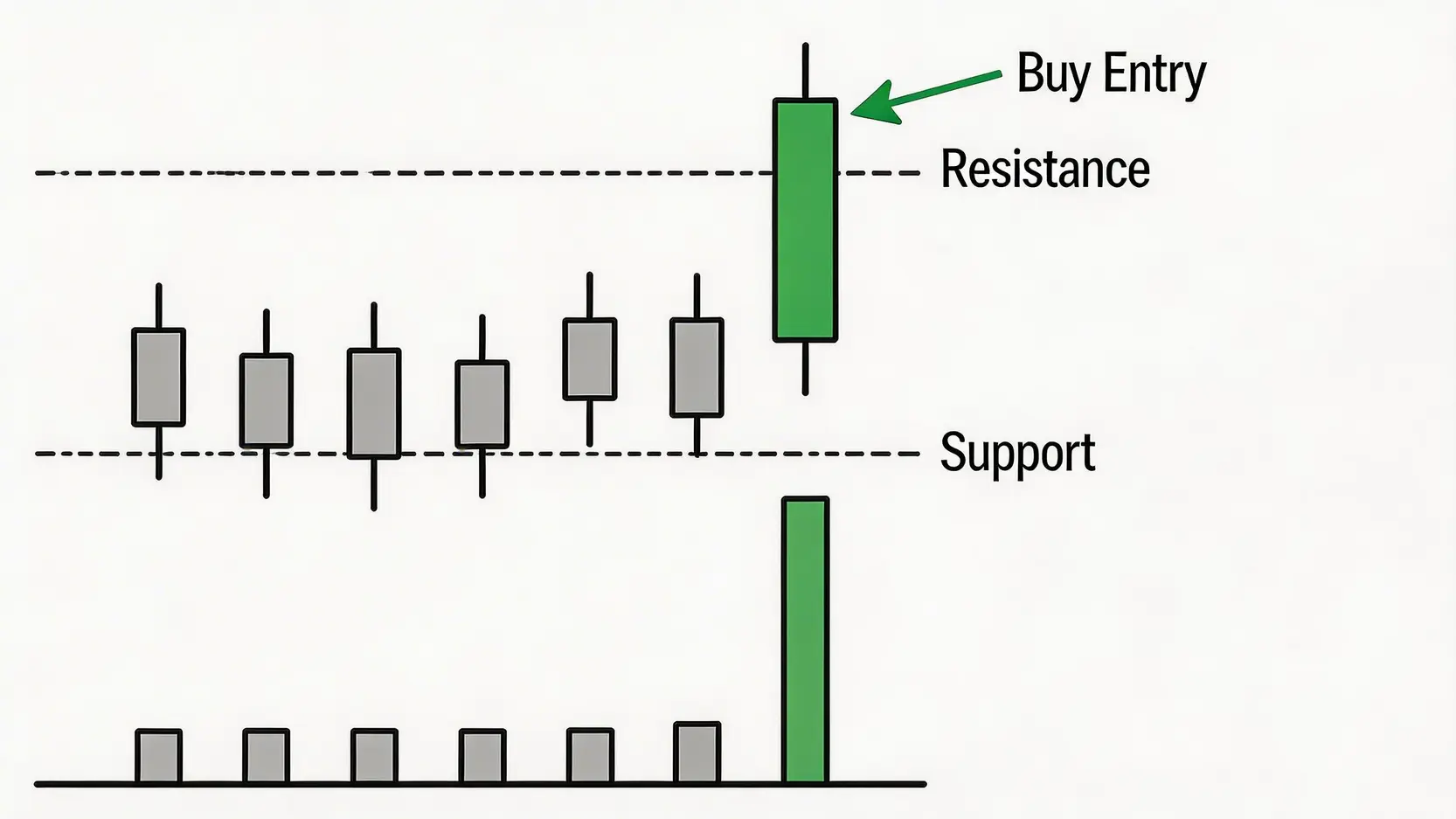
When the market is in a consolidation phase, the price will fluctuate within a specific range. The top of this range is called the “resistance zone”, and the bottom is called the “support zone”. The breakout strategy aims to anticipate and capture the moment when price breaks through these key ranges.
- Method: Observe the high and low within a period of time (for example 30 minutes or 1 hour). Connecting these points forms a price channel.
- Execution: When the price breaks above the resistance zone with significant volume (noticeable increase in trading volume), quickly enter a long position; when the price breaks below the support zone with volume, quickly enter a short position. To avoid false breakouts, some traders wait for a retest of the broken resistance/support level before entering after confirmation.

Breakout Strategy: When price breaks through a key resistance zone with volume, it is a potential entry signal.
Strategy 3: Technical Indicator Application (Moving Average, RSI) – Practical Interpretation of Short-Term Futures Signals
Technical indicators help us analyze the market more objectively. For short-term trading, the following two indicators are very practical:
- Moving Average (MA): In addition to identifying trends, MA crossovers can also provide trading signals. For example, when a short-term moving average (such as the 5MA) crosses above a long-term moving average (such as the 20MA), it is called a “golden cross”, which is a buy signal; the opposite is a “death cross”, which is a sell signal.
- Relative Strength Index (RSI): RSI is used to measure overbought and oversold conditions, with values ranging from 0 to 100. Generally, when RSI is above 70, it is considered overbought and the market may pull back, representing a potential selling point; when below 30, it is considered oversold and the market may rebound, representing a potential buying point. Note: In strong trending markets, RSI may remain in overbought or oversold zones for a long time. In such cases, trend analysis must be combined to avoid premature counter-trend trades.
Strategy 4: Opening Price Trading Method – Capturing the Golden Opportunity in the First Hour of Trading
Many markets experience the highest volatility in the first hour after opening, as accumulated overnight news and sentiment are released in a concentrated manner. The Opening Range Breakout (ORB) method takes advantage of this.
- Execution: Record the highest and lowest prices within a specific period after the market opens (for example the first 30 minutes or 60 minutes) to form an “opening range”. When the price later breaks above the highest point of this range, execute a buy; when it breaks below the lowest point, execute a sell.
- Advantage: This strategy is simple in logic and effectively captures the main directional momentum of the day.
Strategy 5: Strict Stop Loss and Take Profit Techniques
This is not an entry strategy, but the most important survival skill. Trading without a stop loss is like driving at high speed without a seatbelt, extremely dangerous.
- How to set Stop Loss:
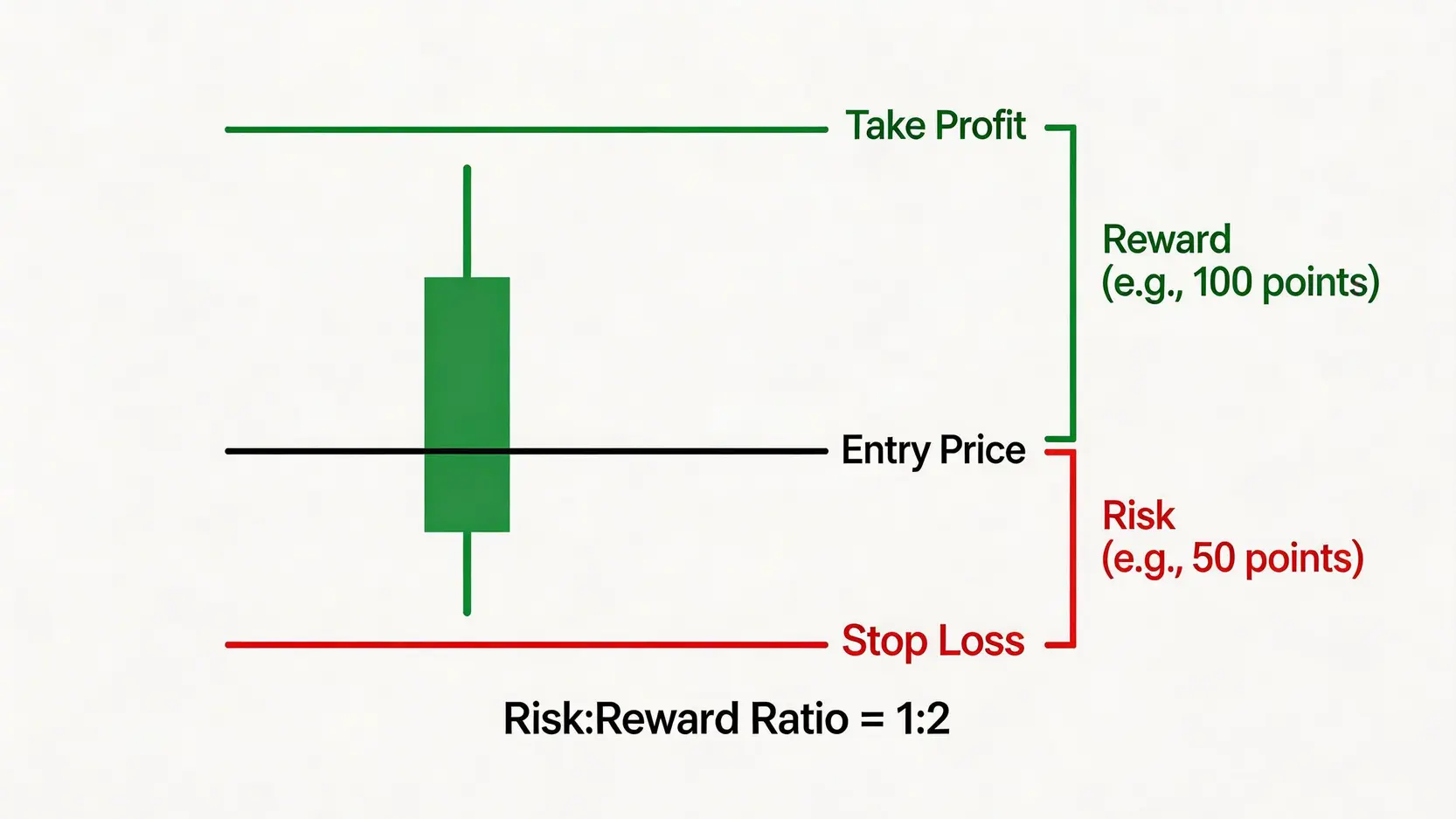
- Technical level stop loss: Set the stop loss on the other side of a key technical level. For example, when going long, place the stop loss below the nearest support level or below the previous swing low.
- Fixed point/amount stop loss: Set a fixed loss point or amount based on your risk tolerance. Once it is reached, exit the trade.
- How to set Take Profit:
- Risk-reward ratio: Calculate it before entering the trade. For example, if your stop loss is 50 points, then the take profit target can be set at 1.5 times or 2 times the risk, meaning 75 points or 100 points.
-

- Setting a reasonable risk-reward ratio (such as 1:2) is key to controlling risk and achieving long-term profitability.
- Trailing takes profit: After you are in profit, you can continuously move the stop loss in the direction of profit to lock in gains while allowing profits to continue running.
Becoming a Successful Trader: Overcoming the Emotional Traps of Short-Term Futures Trading
The biggest difference between top traders and retail traders is rarely strategy, but psychological discipline. Day Trade is an extreme test of human nature, where greed and fear are amplified to the maximum.
The Importance of Discipline: Why Your Trading Plan Is Your Shield?
Before the market opens, you must prepare a detailed trading plan, which should include:
- Entry conditions: What signals must appear before I enter a trade? (for example: breakout of previous high, MA golden cross)
- Exit conditions: Where is my stop loss set? Where is my take profit target?
- Position size: How many contracts should I take for this trade?
Once the market opens, your only task is to “execute” this plan. A trading plan allows you to detach from chaotic emotions and rely on rational rules to deal with market uncertainty. It is your shield in a market full of temptation and fear.
How to Handle Losses and Greed
Losses are part of trading. No one can be right all the time. The key is how you deal with them.
- Accept losses: Do not view losses as failure, but as the necessary cost of running a business. A stop loss is protecting your capital and ensuring you still have the opportunity to trade again.
- Avoid revenge trading: After a loss, never try to “win the money back” immediately by increasing your position. This usually leads to even greater losses.
- Control greed: When trades go well, do not become overconfident by increasing position size or ignoring your take profit plan. The market can reverse at any time and wipe out your profits.
Understanding the investment psychology behind trading strategies helps build a more stable trading mindset.
Further Reading (Highly Recommended)
Futures Trading App Recommendations: 5 Apps Favored by Experts (Fees/ Stability/ Download)
CFD Trading Strategies: 2026 Complete Guide to CFDs, Avoid 7 Critical Risks!
Futures Intraday Trading FAQ (FAQ)
Q: What is the minimum capital required for futures intraday trading?
A: It depends on the futures contract you trade. For example, for mini Hang Seng Index futures, assuming each contract requires a margin of about 20,000 HKD, and considering the 2% risk management rule plus sufficient buffer for price fluctuations, an initial capital of at least 100,000 HKD is generally more stable. The more capital you have, the stronger your ability to withstand risk.
Q: What is the main difference between futures short-term trading and stock short-term trading?
A: There are three main differences: 1. Leverage: Futures inherently have high leverage, while stock short-term trading usually has lower leverage or none unless margin financing is used. 2. Direction: Futures allow easy long (buy) and short (sell) positions, making trading more flexible; shorting stocks has more restrictions. 3. Trading costs: Futures usually have lower transaction taxes than stocks, but fee structure still needs attention.
Q: Are there any recommended futures trading demo platforms?
A: Almost all mainstream futures brokers offer demo accounts. Before using real capital, beginners are strongly advised to practice on a demo account for at least 1 to 3 months. This helps you become familiar with platform operations, validate trading strategies, and experience market rhythm with zero financial risk.
Q: How to deal with rapidly changing market conditions?
A: First, accept that you cannot predict all market movements. Second, strictly follow your trading plan and stop loss rules, which are the best protection against sudden changes. Third, if the market behavior does not match your strategy or you experience consecutive losses, the best approach is to pause trading, step away from the screen, and avoid emotional decisions.
Conclusion
In summary, successful futures intraday trading does not rely on a single Day Trade technique, but on a combination of well-structured short-term futures strategies, strict risk management, and stable psychological discipline. This is a continuous path of learning and refinement. It is hoped that this guide helps you build the right trading mindset, and from today onward, by creating and executing your trading plan, you can gradually master the essentials of short-term futures trading and take your first steady step toward consistent profitability in the futures market.
- Setting a reasonable risk-reward ratio (such as 1:2) is key to controlling risk and achieving long-term profitability.
Related Articles
-
Practical Applications of Volatility Surfaces: From Options Modeling to Advanced Skew Trading Strategies In options markets, implied volatility is never a flat line. Instead, it forms complex "smile" or "skew" surfaces. For advanced traders, mastering the practical applications of volatility surfaces is equivalent to possessing a lens that reveals market...2026 年 6 月 3 日
-
Building a Foreign Capital Flow Copy Trading Model: A Stock Market Indicator for Accurately Tracking Institutional Positioning In Asia-Pacific stock markets, foreign capital inflows and outflows often determine the direction of the index. However, simply looking at daily net buy and sell data is no longer enough. Only by building...2026 年 6 月 3 日
-
Options Buyer Strategies During Extreme Market Conditions: Black Swan Hedging and Cross-Market Arbitrage During Volatility Surges The most terrifying aspect of financial markets is not a gradual decline, but overnight flash crashes and cross-market capital withdrawals accompanied by volatility surges. In the highly unpredictable global macroeconomic environment of 2026, geopolitical...2026 年 6 月 3 日