What Cryptocurrencies Exist? A Complete Guide to Understanding the Differences between Mainstream Coins, Altcoins, and Meme Coins (Beginner Guide)
Just stepping into the cryptocurrency world and already overwhelmed by the thousands of “coins” out there? You may have heard of Bitcoin, but still feel confused about what Altcoins are and the meme coin introductions frequently discussed online. What are the main categories of virtual currencies in the market? How do their risks and investment potential differ? This article will give you a complete breakdown, from definitions to risks and investment potential, helping you quickly establish a clear investment map and avoid unnecessary risks.
Overview of the Virtual Currency World: It Is More than Just Bitcoin!
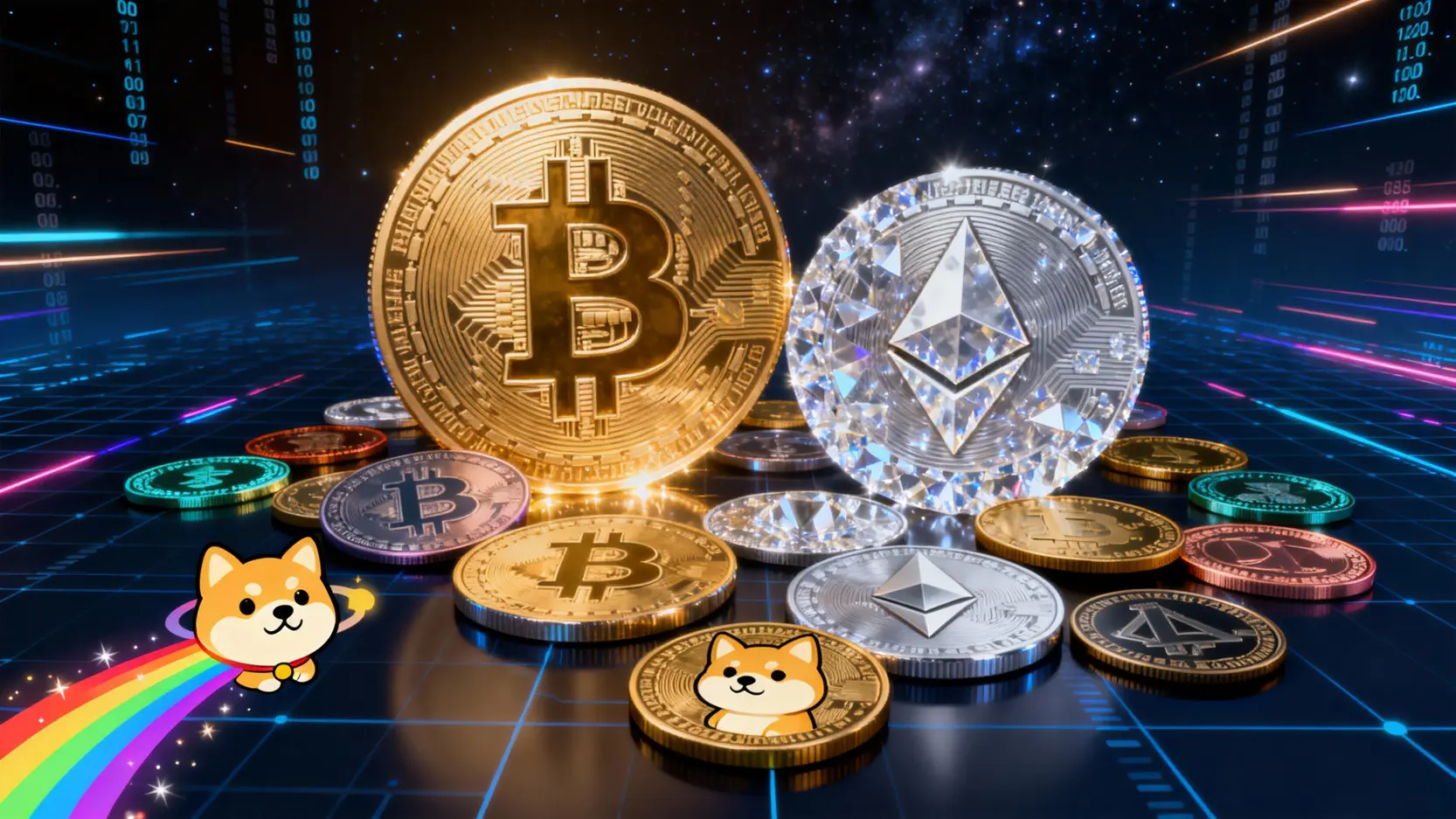
Many beginners assume “virtual currency = Bitcoin”, but this is a common misconception. Although Bitcoin (Bitcoin, BTC) is the pioneer, the entire cryptocurrency ecosystem has grown extremely vast and diverse. Aside from Bitcoin, all other cryptocurrencies are collectively known as “Altcoins”, meaning alternative currencies or substitute coins. We can first categorize the virtual currencies in the market into the following major groups:
Mainstream Coins: The Foundation of the Market
Mainstream coins typically refer to cryptocurrencies with the highest market capitalization, strongest consensus, and longest history. They act as the market’s benchmark, and their price movements often influence overall market sentiment.
- Bitcoin (BTC): As the first decentralized digital currency, it is known as “digital gold”. Its primary value lies in its scarcity (a total supply of 21 million) and its function as a store of value.
- Ethereum (ETH): It is more than just a currency; it is an open-source blockchain platform that allows developers to build and deploy decentralized applications (DApps) and smart contracts. This also makes Ethereum the core foundation for the development of DeFi (decentralized finance), NFT (non-fungible tokens), and other sectors.
Investing in mainstream coins is relatively stable, highly liquid, and is the first choice for most beginners entering the market.
Stablecoins: A Value-Stable Bridge
Stablecoins are a type of cryptocurrency pegged to specific “stable” assets, most commonly at a 1:1 ratio with the US dollar. Their existence provides a safe haven in the highly volatile cryptocurrency market.
- Primary functions: Serve as a medium of exchange, a store of value, and a bridge for entering and exiting the crypto market. When investors want to temporarily exit high-risk positions without converting funds back to fiat currency, they exchange into stablecoins.
- Common examples: USDT (Tether), USDC (USD Coin).
What Are Altcoins? Exploring the Next Potential Star
When hearing the term “Altcoin”, many people may associate it with imitation or inferior products. However, in the cryptocurrency space, the definition of “Altcoin” goes far beyond that. Understanding what altcoins are is an essential step in discovering potential investment opportunities.
The True Definition of Altcoins: They Are More than Just “Imitations”
Altcoin is short for “Alternative Coin” and generally refers to all cryptocurrencies other than Bitcoin. Many high-quality altcoins are not merely copies of Bitcoin; they improve on certain Bitcoin shortcomings (such as slow transaction speed or limited scalability) or create entirely new application scenarios.
Their goal is to become a “better Bitcoin” or to provide unique solutions in specific fields such as finance, gaming, and the Internet of Things.
Popular Altcoins (For Example: Ethereum Killers, DeFi Concept Coins)
Altcoins come in a wide variety, each with different technologies and objectives. The following are several popular categories:
- Ethereum Killers: These altcoins aim to address Ethereum network congestion, high transaction fees, and provide higher-performance smart contract platforms. Notable examples include:
- Solana (SOL): Known for its astonishing transaction speed and low costs.
- Cardano (ADA): Emphasizes its academic research background and layered architecture, aiming for higher security and sustainability.
- DeFi Concept Coins: These tokens are at the core of the decentralized finance ecosystem, used for lending, trading, liquidity mining, and more. For example:
- Uniswap (UNI): Represents the governance token of a decentralized exchange (DEX).
- Chainlink (LINK): Acts as an “oracle”, securely providing real-world data from outside the blockchain to smart contracts.
How to Evaluate the Investment Potential And Risks Of Altcoins?
The appeal of investing in altcoins lies in their enormous growth potential, but the associated risks are also higher. When evaluating an altcoin project, you can consider the following aspects:
- 📄 Whitepaper (Whitepaper): Carefully read the project’s whitepaper to understand whether its technology, vision, and the problems it aims to solve truly exist.
- 👥 Team (Team): Are the team members’ backgrounds transparent? Do they have relevant successful experience in the field?
- 🛠️ Technology & Use Case (Technology & Use Case): Does the project have real-world applications? Is the technology innovative and defensible?
- 💰Tokenomics (Tokenomics): The total token supply, distribution method, and release schedule will directly affect its future value.
- 🌐 Community (Community): An active and loyal community is an important support for the project’s long-term development. You can observe this on platforms like Twitter and Discord.
Remember, the altcoin market is full of opportunities but also rife with scam projects. Always conduct your own research (Do Your Own Research, DYOR) before investing.
Meme Coin Introduction: An Investment Frenzy Fueled by Community Power
When discussing virtual currencies, the dramatic “meme coins” cannot be overlooked. The rise of this type of currency perfectly demonstrates how community consensus and internet culture can influence financial markets.
Origin and Cultural Characteristics of Meme Coins (Using Dogecoin as an Example)
The pioneer of meme coins is Dogecoin (Dogecoin, DOGE), which was created in 2013. It originally started as a joke among engineers, featuring a cute Shiba Inu as its symbol. It had no grand technical roadmap and no intention of solving world problems; its core value was simply “fun” and the culture of community tipping. However, this playful, anti-traditional nature, combined with the influence of celebrities (such as Elon Musk), propelled Dogecoin’s market value to soar, spawning countless followers like Shiba Inu (SHIB). The core driving force of meme coins often lies not in technology, but in community enthusiasm, online hype, and the dream of getting rich quickly.
Three Key Risks to Know Before Investing in Meme Coins: High Volatility, Lack of Practical Use, Community Influence
Meme coins can bring astonishing returns in a short period, but their risks are extremely high. Investors must be fully aware of the following before investing:
- Extremely High Volatility: Meme coin prices are primarily driven by market sentiment and social media hype, lacking fundamental support. Prices can surge based on a single statement or collapse when the hype fades, with fluctuations far exceeding those of mainstream coins and altcoins.
- Lack Of Practical Use: Most meme coins have almost no real-world application or technological value beyond speculation. When the hype subsides, their value can quickly drop to zero.
- Susceptible To Influence From Celebrities And Communities: Prices are highly sensitive to statements from large holders (whales) or community leaders, creating “pump and dump” scenarios where retail investors are often left holding the losses.
For meme coins, it is more appropriate to treat them as a high-risk form of entertainment, with invested funds being “spare money that would not affect your life even if fully lost”.
At a Glance: Mainstream Coins vs. Altcoins vs. Meme Coins
To help you more intuitively understand the differences among these three, the following is a detailed comparison table, allowing you to grasp the characteristics of different virtual currencies at a glance.
[Comparison Table] Comprehensive Analysis from Technology, Risk, and Investment Potential
| Features |
Mainstream Coins |
Altcoins
|
Meme Coins |
| Origin And Purpose |
Innovative technology, aimed at becoming digital gold or a decentralized platform. |
Improves existing technology or creates applications in specific fields. |
Originates from internet jokes and community culture, with a high entertainment value. |
| Core Value |
Strong consensus, security, decentralization. |
Technological innovation, solutions, ecosystem applications. |
Community popularity, celebrity influence, hype. |
| Risk Level |
Relatively Low |
Medium to High |
Extremely High |
| Investment Potential |
Stable growth, long-term value storage. |
If the project succeeds, it may achieve tens or even hundreds of times high growth. |
May experience over a thousandfold short-term surge, but the risk of dropping to zero is extremely high. |
| Representative Examples |
BTC, ETH |
SOL, ADA, LINK, UNI |
DOGE, SHIB, PEPE |
Beginner Investment Advice: How Should I Choose?
For novice investors, a prudent strategy is to start with mainstream coins.
- Build a Core Position: Allocate the majority of funds (for example, 60-80%) to mainstream coins such as Bitcoin and Ethereum, using them as the core of a long-term investment.
- Small Exploration Into Altcoins: After gaining a certain understanding of the market, allocate a small portion of funds (for example, 10-20%) to research and invest in altcoins with real-world application potential and strong teams.
- Be Cautious With Meme Coins: If interested in meme coins, use only a very small portion (for example, 1-5%) of spare money, and be mentally prepared for potential total loss.
Most importantly, portfolio allocation should align with personal risk tolerance, and never invest more than you can afford to lose.
Frequently Asked Questions (FAQ)
Q: What Is the Difference between Altcoins and Meme Coins?
A: The main difference lies in “purpose” and “value support”. Altcoins usually have clear technical objectives or application scenarios, aiming to solve specific problems, and their value is related to technological development and market adoption. Meme coins, however, often originate from internet culture, lack substantive technical support, and their value heavily depends on community hype and market sentiment, making them more speculative.
Q: Which Type of Cryptocurrency Should Beginners Invest in First?
A: It is generally recommended that beginners start with the largest and most liquid mainstream coins, especially Bitcoin (BTC) and Ethereum (ETH). Their market information is more transparent, risks are relatively lower, and they help beginners build foundational knowledge while steadily experiencing the operation of the cryptocurrency market.
Q: How Do I Buy Altcoins or Meme Coins?
A: There are mainly two purchasing channels: centralized exchanges (CEX) and decentralized exchanges (DEX). Major centralized exchanges such as Binance and Coinbase list more well-known and potentially promising altcoins. Newer and more niche meme coins usually require using decentralized exchanges like Uniswap or PancakeSwap, exchanging through a crypto wallet such as MetaMask.
Q: Are All Altcoins Worth Investing in?
A: Absolutely not. There are tens of thousands of altcoins on the market, and the vast majority of projects will ultimately fail or drop to zero. Successful projects are very few. Therefore, it is essential to conduct thorough and independent research before investing in any altcoin, and never follow trends blindly.
Q: Where Can I Find Information on Various Cryptocurrencies?
A: There are many authoritative data websites where you can check real-time cryptocurrency prices, market capitalization, trading volume, and other information. For example, CoinMarketCap and CoinGecko are among the most commonly used and comprehensive international platforms, offering multilingual interfaces and serving as essential tools for researching virtual currencies.
Conclusion
In summary, understanding the classification of “what cryptocurrencies exist” is the first step to successful investing. From mainstream coins that serve as the market’s foundation, to innovative and potentially high-growth “altcoins”, and to community-driven, high-risk, high-reward “meme coins”, each type has its unique market positioning and risk profile. This in-depth analysis of what altcoins are, along with the detailed introduction of meme coins, aims to help you make wiser investment decisions that align with your risk tolerance when entering this market full of opportunities and challenges.