What Is AUD? Australian Dollar Guide for Beginners

Updated: 2026/03/17  |  CashbackIsland

aud-currency-guide

[Complete Guide to Australian Currency] What Is the Australian Dollar? Understand the AUD Symbol, Banknotes, and Coin Denominations in 5 Minutes

Whether you are planning to travel to Australia, study abroad, or begin a working holiday adventure, the first thing you need to understand is the local currency: the Australian dollar (AUD). What exactly is the Australian dollar? Among the colorful banknotes in circulation, how can you quickly identify different Australian dollar denominations? As a comprehensive introduction to Australian currency, this article serves as your ultimate guide. Starting with the basic concept of the AUD symbol, it will break down all banknote and coin denominations in detail, helping you prepare before departure and ensuring smooth and confident spending in Australia.


What Is the Australian Dollar? Understanding Australia’s Currency (AUD)

The Australian dollar is the official currency of Australia. In addition to circulating within Australia, it is also used as legal tender in several Pacific island nations such as Nauru, Tuvalu, and Kiribati. Understanding its basic characteristics is the first step toward gaining insight into Australia’s financial and economic environment.


Australian Dollar Overview: The World’s Fifth Most Traded Currency

The Australian dollar (currency code: AUD) plays an important role in the global foreign exchange market, ranking as the fifth most traded currency in the world, behind the US dollar, euro, Japanese yen, and British pound. This position largely stems from Australia’s stable political environment, relatively higher interest rates, and its abundant natural resource exports.

It is also worth noting that the Australian dollar is widely regarded as a “commodity currency”, meaning its exchange rate is closely linked to the prices of Australia’s key export commodities (such as iron ore, coal, and gold). When global demand for these resources increases and prices rise, the AUD exchange rate often strengthens as well. For investors interested in learning forex trading, understanding the relationship between the Australian dollar and the global commodity market is an essential concept.


Decoding the Australian Dollar Symbol: A$ or AUD?

In everyday use and financial transactions, you will commonly see two symbols representing the Australian dollar. Understanding the difference between them is important:

  • A$: This is the most commonly used written symbol for the Australian dollar and is usually placed before the amount, for example A$100. The letter “A” is used to distinguish it from other currencies that also use the “$” symbol (such as the US dollar (US$) or the Canadian dollar (C$)).
  • AUD: This is the international currency code defined by the International Organization for Standardization (under the ISO 4217 standard). It is mainly used in international financial markets, foreign exchange trading, and banking systems to ensure clear and accurate currency identification worldwide.

In simple terms, when you see price tags in local Australian shops, they will most likely use “$” or “A$”. When making international transfers or checking foreign exchange rates, you will typically see the code “AUD”.


Illustrated Guide to Australian Currency: A Complete Overview of Australian Banknote and Coin Denominations

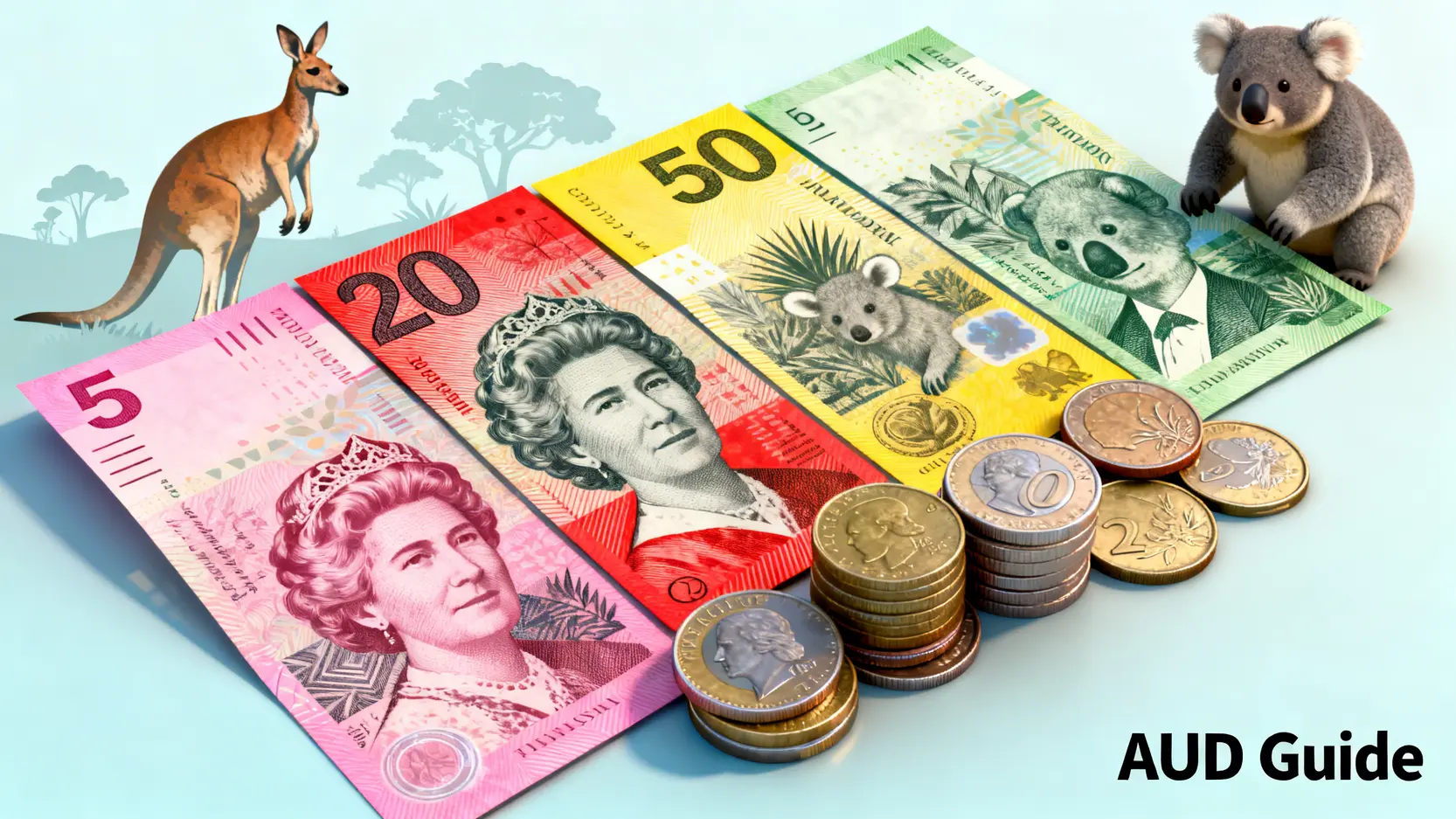
一張展示所有澳洲貨幣面額的圖片,包括五種顏色的澳元紙幣和六種不同大小的硬幣。

Overview of Australian Currency: From colorful polymer banknotes in denominations from 5 dollars to 100 dollars, to distinctive coins ranging from 5 cents to 2 dollars.

Australia’s currency system is both beautifully designed and highly practical, especially its banknotes, which are renowned for their unique material and vivid colors. Below is a detailed illustrated guide to the various Australian banknote denominations and coins.

Overview of Australian Banknote Denominations: Waterproof and Secure Polymer Banknotes

Australia was the first country in the world to fully introduce polymer banknotes. These banknotes are not only waterproof and durable, but more importantly, they incorporate highly advanced anti-counterfeiting technology, such as transparent windows and dynamic images. According to the Reserve Bank of Australia, their design is extremely difficult to counterfeit.

There are currently five main denominations of Australian banknotes in circulation:

Denomination Primary Color Portrait (Front) Design (Back)
$5 Purple Queen Elizabeth II Parliament House
$10 Blue Poet Banjo Paterson Poet Dame Mary Gilmore
$20 Red Businesswoman Mary Reibey Royal Flying Doctor Service Founder John Flynn
$50 Yellow Aboriginal Writer and Inventor David Unaipon Australia’s First Female Member of Parliament Edith Cowan
$100 Green Soprano Dame Nellie Melba General Sir John Monash


Overview of Australian Coin Denominations: From 5 Cents to 2 Dollars

Australian coins are also distinctive in design, especially the images on the reverse side, which feature several animals unique to Australia and are highly collectible.

  • 5 cents (5c): Silver, the smallest coin. The reverse features an echidna (Echidna).
  • 10 cents (10c): Silver, larger than the 5-cent coin. The reverse features a superb lyrebird (Superb Lyrebird).
  • 20 cents (20c): Silver, larger than the 10-cent coin. The reverse features a platypus (Platypus).
  • 50 cents (50c): Silver, the largest coin, with a distinctive 12-sided shape. The reverse features the Australian coat of arms.
  • 1 dollar ($1): Gold, smaller than the 50-cent coin. The reverse features five kangaroos and is often called the “Kangaroo coin”.
  • 2 dollars ($2): Gold, the smallest gold-colored coin. The reverse features an Aboriginal elder and the Southern Cross.

Kind Reminder: Australia stopped circulating the 1-cent and 2-cent coins in 1992. Therefore, in cash transactions the total amount is rounded according to “standard rounding” rules. Amounts ending in 1 or 2 cents are rounded down, 3, 4, 6, or 7 cents are adjusted to 5 cents, and 8 or 9 cents are rounded up to 10 cents. However, electronic payments are not subject to this rule and are calculated precisely to the cent.


Further Reading (Highly Recommended)

2026 Forex Trading Beginner Guide: Master Risk Management and Broker Selection for Stable Profits

[2025 Euro Investment Guide] Is Now a Good Time to Buy? Experts Analyze the Best Timing and Three Major …


Main Factors Affecting the Australian Dollar Exchange Rate

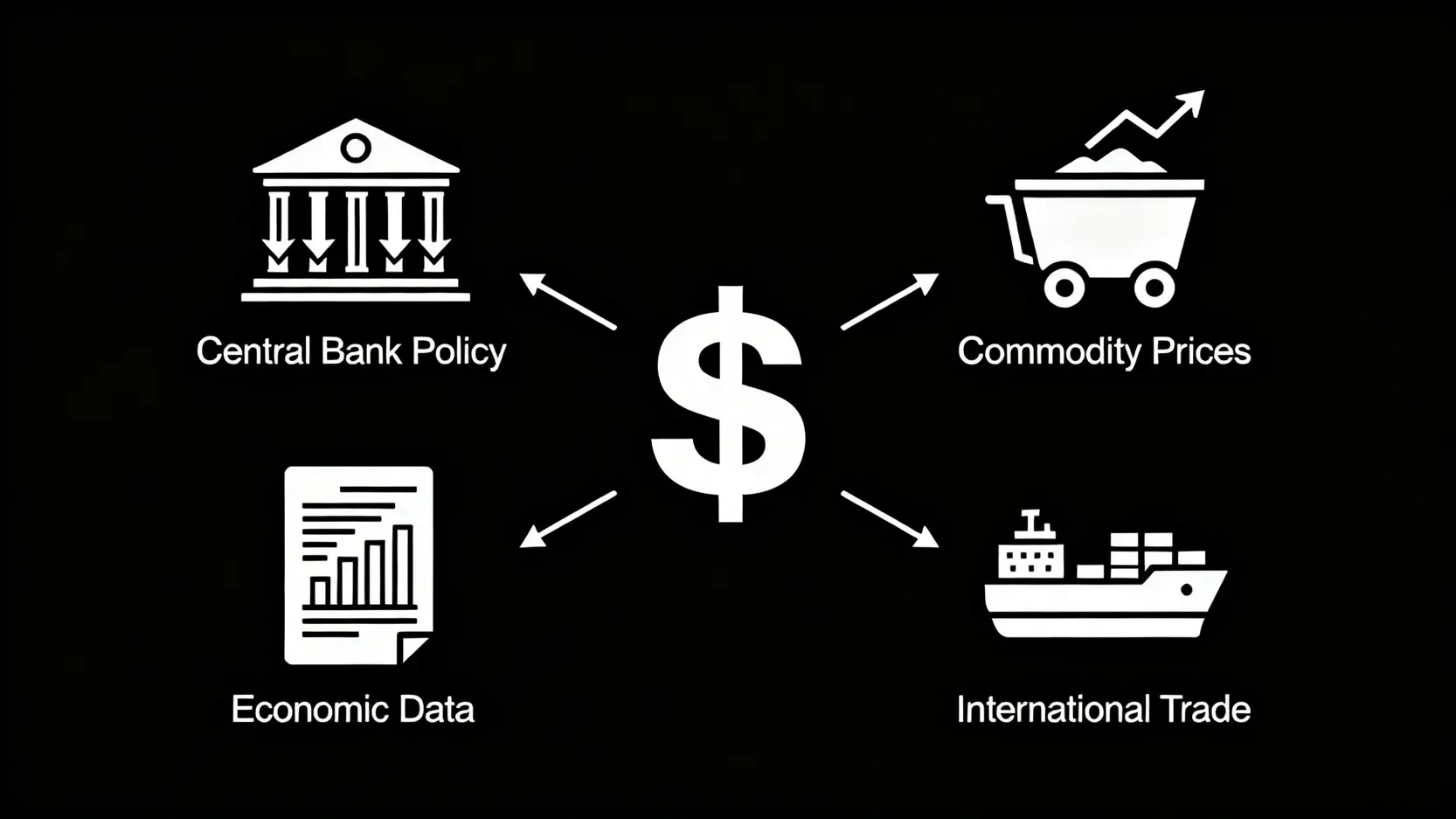
影響澳元匯率的四大因素示意圖,包括央行政策、大宗商品價格、經濟數據和國際貿易。

The four key factors affecting the Australian dollar exchange rate are closely interconnected.

For those who need to exchange large amounts of Australian dollars or are considering investment, understanding the factors that influence fluctuations in the Australian dollar exchange rate is crucial. The following are several key points you should closely monitor:


Monetary Policy of the Reserve Bank of Australia (RBA)

The Reserve Bank of Australia (Reserve Bank of Australia, RBA) is Australia’s central bank. Its monetary policy, especially decisions regarding the Official Cash Rate, has the most direct impact on the Australian dollar exchange rate. Generally speaking:

  • Rate Hike: When the RBA raises interest rates to curb inflation, it attracts more overseas capital into Australia seeking higher returns, thereby pushing the Australian dollar exchange rate higher.
  • Rate Cut: Conversely, when the economy requires stimulus, the RBA may lower interest rates, reducing the attractiveness of the Australian dollar and potentially causing the exchange rate to decline.

Commodity Prices

As mentioned earlier, Australia is one of the world’s major resource exporters. Fluctuations in international market prices for commodities such as iron ore, coal, natural gas, and gold directly affect Australia’s trade revenue and consequently influence market confidence in the Australian dollar. For example, when iron ore prices surge, it usually creates appreciation pressure on the Australian dollar.


Key Economic Data

Like other countries, Australia’s economic data also serves as a barometer for its exchange rate. Key indicators include:

  • Gross Domestic Product (GDP): Reflects the overall health of economic growth.
  • Consumer Price Index (CPI): Measures inflation levels and influences the RBA’s interest rate decisions.
  • Employment Data: Unemployment rates and employment growth figures indicate the strength of the labor market.
  • Trade Balance: The difference between exports and imports. A larger surplus is generally favorable for the Australian dollar.

To gain a deeper understanding of the economic indicators that influence exchange rates, further study of relevant financial knowledge is recommended.

China’s Economic Performance

China is Australia’s largest trading partner and has strong demand for Australia’s natural resources. Therefore, China’s economic growth rate, industrial production data, and any major economic policy changes can affect Australia’s export outlook, indirectly influencing the movement of the Australian dollar. The market sometimes even views the Australian dollar as a “proxy currency” for China’s economy.


Conclusion

In summary, the Australian dollar (AUD) is not only a uniquely designed, colorful, and technologically advanced currency, but also an important member of the global financial system. Through this detailed introduction to Australian currency, you should now have a comprehensive understanding of the Australian dollar symbol, the various Australian banknote denominations, and coin features. From now on, whether you encounter price tags in Australian stores or the colorful polymer banknotes in your wallet, they will no longer feel unfamiliar. Understanding these basics will provide a solid foundation for your travels to Australia or your investment planning.


Frequently Asked Questions About Australian Currency (FAQ)

Q: What is the official currency used in Australia?

A: Australia’s official currency is the Australian dollar. Its international currency code is AUD, and the commonly used symbol is A$. All transactions within Australia are settled in Australian dollars.

Q: What material are Australian banknotes made from? Why do they feel different from other banknotes?

A: Australian banknotes are not made of paper but are produced from a plastic material called polymer. Australia was the first country in the world to fully adopt this type of banknote. This material makes Australian banknotes highly durable, waterproof, and difficult to tear. More importantly, it incorporates multiple high-tech anti-counterfeiting features, providing extremely high security.

Q: Where is the best place to exchange Australian dollars when traveling to Australia?

A: Generally, there are several main channels for exchanging Australian dollars. Exchanging at banks or licensed money changers in your departure location usually offers better exchange rates. After arriving in Australia, airport exchange counters are convenient but typically offer the worst rates. Exchanging at banks or money changers in Australian city centers is also an option. The most ideal approach is to compare exchange rates and fees across different channels before departure and then make a decision. In addition, using a debit card or credit card with favorable overseas withdrawal benefits is also a good method.

Q: How many cents equal one Australian dollar?

A: Like many countries’ currency systems, 1 Australian dollar ($1) equals 100 cents. Although the smallest coin currently in circulation is 5 cents, all electronic transactions are calculated precisely to the cent.

Q: Why do cash payments in Australia sometimes result in receiving slightly more or less change by a few cents?

A: This is because Australia has phased out the 1-cent and 2-cent coins. When you pay with cash, if the final amount does not end in 0 or 5, the cashier will apply “standard rounding” rules. For example, a total of $9.98 will be rounded to $10.00, while $9.92 will be rounded to $9.90. This rule only applies to cash transactions. Card payments or electronic payments are not affected.

编者
Evan Lin

Evan Lin

我是Evan Lin,从大学时期开始接触外汇交易,至今已有多年实战经验,熟悉技术分析与EA策略,热衷于研究市场脉动与风险管控,喜欢分享实战经验和交易技巧,和大家一起学习、一起进步!

If you liked this article, please share it!

Related Articles

  • US Oil Inventories Fall 13 Weeks: Will Prices Surge?
    US Crude Oil Inventories Fall for 13 Consecutive Weeks: Are Oil Prices About to Soar? Complete Analysis of the Latest Market Impact in 2026 International oil prices have recently shown signs of rising. Are you also worried about higher living costs? This is closely related to the major news that...
    2026 年 7 月 20 日
  • WTI Crude Oil at $80: 5 Key Drivers and Strategies
    Understanding the US$80 WTI Crude Oil Threshold: Five Core Factors Influencing Oil Prices and the Latest Investment Strategies Recently, global market attention has once again turned to the energy market, with WTI crude oil prices repeatedly fluctuating around the US$80 threshold as bulls and bears engage in an intense battle....
    2026 年 7 月 20 日
  • NOK/USD Analysis: How Energy Prices Drive the Krone
    NOK/USD Energy Market Analysis: How Do Oil and Natural Gas Prices Drive the Norwegian Krone? The Norwegian krone (NOK) is one of the currencies most heavily influenced by energy prices worldwide, and its exchange rate against the US dollar (USD) is often closely linked to international oil and natural gas...
    2026 年 7 月 20 日
返回顶部