Japanese Yen Investment 2026: USDJPY & EURJPY Guide

[Japanese Yen Investment Guide] USDJPY Trading and EURJPY Cross Pairs: Five Steps to Master Profit Strategies
Recently, the Japanese yen exchange rate has been highly volatile. Whether you are planning a trip to Japan or are a trader focused on foreign exchange investment, this has brought new challenges and opportunities. Many beginner investors feel both curious and confused about “Japanese yen currency pairs”, unsure how to choose between the most popular USDJPY trading and EURJPY cross pairs in the market, or how to position themselves strategically. This article serves as your complete guide to trading Japanese yen currency pairs. From fundamental concepts to advanced practical strategies, it will guide you through five simple steps to learn how to analyze market dynamics and gradually build your own profit formula. Dive deep into the mysteries of Japanese yen trading!
Understanding the Basics of Japanese Yen Trading: What Are Japanese Yen Currency Pairs?
Before entering the foreign exchange market, the first task is to understand the core concept of “currency pairs”. A currency pair, as the name suggests, is a quotation of the exchange rate between two currencies. For example, USD/JPY represents how many Japanese yen one US dollar can be exchanged for. In Japanese yen related trading, currency pairs can mainly be divided into two categories: direct pairs and cross pairs.
Direct Currency Pair Analysis: Using “USD/JPY Trading” as an Example
A “direct pair” refers to any currency pair that is directly exchanged against the US dollar (USD). As the US dollar is the world’s dominant reserve currency and trading medium, direct currency pairs have the largest trading volume and the highest liquidity. USD/JPY (US dollar/Japanese yen) is the most typical example and is also known as “The Gopher”.
- Quotation Method: USD/JPY equals 145.50 means that 1 US dollar can be exchanged for 145.50 Japanese yen.
- Trading Logic: When you expect the US dollar to appreciate against the Japanese yen (for example due to a Federal Reserve rate hike), you would “buy” USD/JPY. Conversely, if you expect the Japanese yen to strengthen (for example if the Bank of Japan ends its accommodative policy) you would “sell” USD/JPY.
- Market Position: USD/JPY is the second most traded currency pair in the world, second only to EUR/USD. Its movements not only reflect the economic strength of the US and Japan, but also serve as an important indicator of global risk sentiment.
Cross Pair Currency Analysis: Using “EUR/JPY Cross Pair” as an Example
A “cross pair” refers to a currency pair that does not involve the US dollar. Its exchange rate is calculated indirectly through each currency’s exchange rate against the US dollar. EUR/JPY (euro/Japanese yen) is a very popular cross currency pair, as it directly reflects the economic relationship between the eurozone and Japan.
- Quotation Method: EUR/JPY equals 160.20 means that 1 euro can be exchanged for 160.20 Japanese yen.
- Trading Logic: Trading EUR/JPY is equivalent to placing a simultaneous bet on the economic outlook of the eurozone and Japan. If you believe the eurozone economy will outperform Japan’s, you can “buy” EUR/JPY. Conversely, you would “sell”.
- Trading Characteristics: Cross pairs are typically more volatile than direct pairs because they are influenced by two non US currencies as well as movements in the US dollar, offering traders different opportunities and risks.
Table Comparison: Trading Pros and Cons of Direct Pairs vs. Cross Pairs
| Characteristics |
Direct Currency Pairs (Using USD/JPY as an Example) |
Cross Currency Pairs (Using EUR/JPY as an Example) |
| Liquidity |
Extremely high, sufficient market depth, low trading costs (spreads). |
High, but lower than direct pairs, with relatively higher spreads. |
| Volatility | Relatively stable, but intensifies during major data releases. | Usually higher, with greater potential profit opportunities and risks. |
| Analysis Difficulty | Relatively straightforward, mainly focusing on US and Japanese economic data and central bank policies. | More complex, requiring consideration of economic conditions in Europe, Japan, and the US simultaneously. |
| Suitable For | Beginners and investors who prefer stable trading. | Experienced traders and investors seeking higher volatility. |
In-Depth Analysis of Two Major Japanese Yen Currency Pairs: USD/JPY vs. EUR/JPY
After understanding the basic definitions, let us take a deeper look at the unique characteristics of these two major Japanese yen currency pairs and the core driving factors that influence their movements. This will help you determine which one is better suited to your trading strategy.
USD/JPY (US Dollar/Japanese Yen): The King of Liquidity and Key Influencing Factors
USD/JPY is known as the “king of liquidity”. Its movements are primarily determined by the monetary policy tug of war between the currencies of the world’s two strongest economies: the Federal Reserve (Fed) and the Bank of Japan (BOJ). Differences in their interest rate decisions are the most fundamental force driving the long-term trend of USD/JPY.
- 💰 Central Bank Policy Divergence: When the Fed leans toward raising interest rates to combat inflation, while the BOJ maintains ultra-low or even negative interest rates, the interest rate differential widens. This attracts substantial capital flows into the US dollar and pushes the USD/JPY exchange rate higher. Conversely, if the BOJ begins to tighten monetary policy, it may lead to an appreciation of the Japanese yen.

- 📊 Key Economic Data: The US Non-Farm Payrolls (NFP), Consumer Price Index (CPI), and gross domestic product (GDP) are market focal points. The strength of these data directly influences Fed decisions and, in turn, can sharply move USD/JPY.
- 🛡️ Risk-Off Sentiment: Traditionally, the Japanese yen is viewed as a safe-haven currency. When global markets face turbulence or uncertainty, such as geopolitical crises, investors sell risk assets and buy the Japanese yen for safety, and USD/JPY typically falls.
EUR/JPY (Euro/Japanese Yen): A Key Indicator Reflecting the Euro-Japan Economic Temperature Gap
The EUR/JPY cross pair is more like a mirror, reflecting the relative strength between the eurozone and Japan, two major economies. Its movements are influenced not only by the policies of the European Central Bank (ECB) and the Bank of Japan (BOJ), but are also highly sensitive to internal conditions within the eurozone.
- 🌍 Euro-Japan Economic Comparison: The trend of EUR/JPY is a direct market vote on the economic outlook of the eurozone versus Japan. For example, if Germany (the eurozone’s economic locomotive) posts strong data while Japan’s data are weak, EUR/JPY may gain upward momentum.
- 🇪🇺 European Central Bank Direction: The ECB’s rate decisions, inflation expectations, and outlook for future growth are key factors influencing the euro’s value. Policy divergence between the ECB and the BOJ is the primary source of EUR/JPY price fluctuations.
- 📈 Risk Appetite Indicator: EUR/JPY is highly sensitive to global risk sentiment. In a “Risk-On” environment, investors tend to chase the higher-yielding euro and sell the low-yielding Japanese yen, pushing EUR/JPY higher. Conversely, it tends to fall in a “Risk-Off” environment.
Which Should I Choose? Make a Decision Based on Trading Style and Market Trends
So, how should you choose between the two?
- Beginner traders or conservative investors: It is recommended to start with USD/JPY. Its analytical logic is relatively clear, mainly centered on US economic data and Fed policy, with lower trading costs and generally steadier price action.
- Experienced traders or trend followers: EUR/JPY offers greater volatility. If you are good at capturing moves driven by European political and economic events, or have sharp insight into global risk sentiment, this cross pair may offer more opportunities.
Ultimately, there is no absolute right or wrong choice. The key is to match it to your knowledge base, risk tolerance, and trading strategy.
Get Started in Five Steps! A Beginner-Only Trading Process for Japanese Yen Currency Pairs
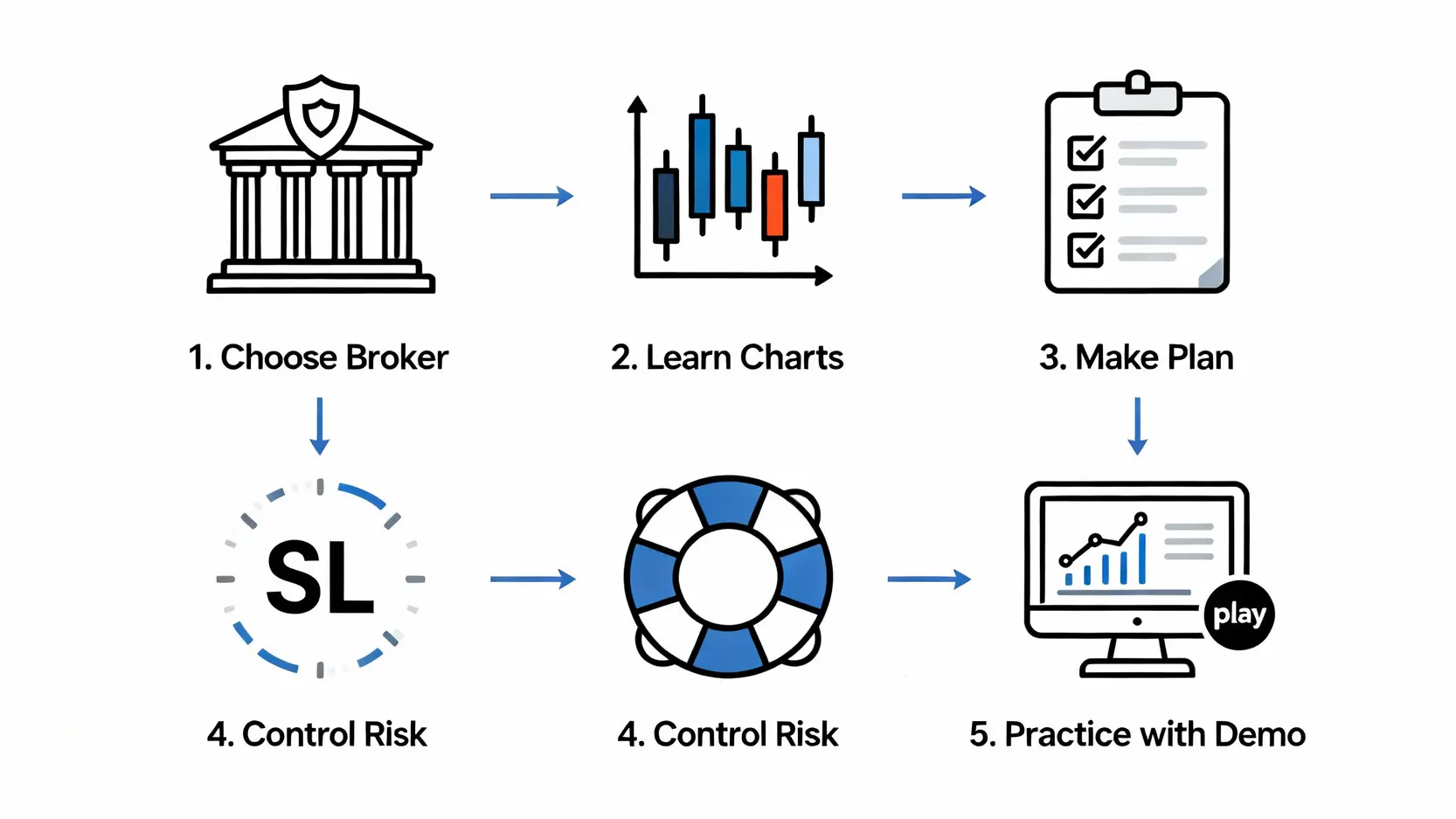
With the theory in place, the next step is hands-on practice. Following the five steps below can help you build a systematic and disciplined trading process, effectively reducing common mistakes during the beginner stage.

Step One: Choose a High-Quality, Regulated Forex Trading Platform
This is the first step in all trading activities and also the most important. A good trading platform safeguards your funds and forms the foundation for smooth execution. When making your choice, pay attention to the following points:
- Strong regulation: Ensure the platform is regulated by top-tier global financial authorities, such as the UK Financial Conduct Authority (FCA) and the Australian Securities and Investments Commission (ASIC).
- Low trading costs: Compare spreads (the difference between buy and sell prices) and overnight interest across platforms, as these directly affect your trading profits.
- Platform stability: Choose platforms that offer stable MT4 or MT5, or proprietary trading software, to ensure fast order execution without slippage.
- Customer service and deposits and withdrawals: Select platforms that provide localized Chinese-language customer support and offer multiple deposit and withdrawal channels with fast processing speeds.
Before making a decision, you can refer to professional forex broker comparisons to find the partner that best suits you.
Step Two: Learn to Read Real-Time Charts and Key Technical Indicators
Price charts are the language of the market. Only by learning to interpret them can you grasp market dynamics. Beginners can start with the following basics:
- Candlestick charts: Learn to identify basic candlestick patterns, such as hammer patterns and engulfing patterns, which reflect the balance of buying and selling forces in the market.
- Trendlines and support and resistance levels: Draw trendlines to determine whether the market is in an uptrend, downtrend, or consolidation. Identifying key support and resistance zones is the foundation for planning entry and exit points.
- Common technical indicators: There is no need to pursue complexity. Start by mastering two to three simple and practical indicators.
- Moving Average (MA): Used to determine trend direction, such as when a short-term moving average crosses above or below a long-term moving average (golden cross or death cross).
- Relative Strength Index (RSI): Used to assess whether the market is in an “overbought” or “oversold” condition, helping to identify potential reversal signals.
Step Three: Create Your Own Trading Plan (Entry, Exit, and Capital Management)
Impulsiveness is the greatest enemy of trading. A clear trading plan helps you stay calm during market volatility. Your plan should include at least the following:
- Entry conditions: What signals must appear before you enter a trade? (For example, price breaks above a key resistance level while RSI has not yet reached the overbought zone).
- Exit conditions:
- Take Profit: At what price level do you plan to lock in profits? This is usually set near the next resistance level.
- Stop Loss: If the market moves against you, what is the maximum loss you are willing to accept? This is your bottom line and must be strictly enforced.
- Capital management: How much capital will you allocate to each trade? Beginners should follow the “2 percent rule”, meaning the maximum loss on a single trade should not exceed 2 percent of total capital.
Step Four: Use Stop-Loss Orders to Control Risk
A stop loss is a trader’s seat belt and a key factor that separates professionals from amateurs. It is a preset order that automatically closes your position when the market price reaches the loss level you have set, preventing losses from expanding without limit.
- Why must you set a stop loss? As no one can predict the market with 100% accuracy. Even the most perfect analysis can be wrong. A stop loss ensures that when you make a mistake, the loss is controllable, allowing you to remain in the market with enough capital to continue.
- How do you set it? Stop-loss placement should be based on technical analysis, not an arbitrary price. Common placements include below the previous swing low, below a key support level, or below a specific moving average.
Step Five: Practice Trading Strategies Risk-Free With a Demo Account
Before you commit real funds, all mainstream trading platforms provide a “demo account”. This is an account that uses virtual funds, but prices are fully synchronized with the live market.
- Practice, practice, and practice again: In a demo account, you can test your trading plan without pressure, become familiar with platform operations, and validate the effectiveness of technical indicators.
- Build confidence: When you can achieve consistent and stable profits in a demo account for a period of time (such as one to three months), it indicates your trading system has begun to take shape. Only then should you consider deploying a small amount of real capital, which is the wise approach.
Frequently Asked Questions About Trading Japanese Yen Currency Pairs (FAQ)
Q: What Is the Best Time to Trade Japanese Yen Currency Pairs?
A: Japanese yen currency pairs are most active during the Asian session (Tokyo time 8:00 a.m. to 4:00 p.m.). However, the largest trading volume and volatility in the global foreign exchange market usually occur during the overlap between the European and North American sessions, roughly from 8:00 p.m. to 12:00 a.m. Taipei time. During this period, both USD/JPY and EUR/JPY often experience larger price swings, providing more trading opportunities.
Q: What Are the Most Important Economic Data That Affect USD/JPY and EUR/JPY?
A: For USD/JPY, the most important data come from the US, including: Federal Reserve interest rate decisions, changes in Non-Farm Payrolls (NFP), and the Consumer Price Index (CPI). For EUR/JPY, in addition to Japan’s data, you also need to closely monitor the eurozone’s inflation rate, Germany’s ZEW Economic Sentiment Index, and the European Central Bank’s interest rate decisions. Both pairs are also influenced by public remarks from central bank governors.
Q: As a Beginner, Should I Start With USD/JPY or EUR/JPY?
A: Generally speaking, beginners are strongly advised to start with USD/JPY. There are three main reasons. First, it has the highest liquidity, which means the lowest trading costs (spreads). Second, the factors influencing its movements are relatively straightforward, mainly centered on US and Japanese macroeconomic conditions, making it easier to analyze. Third, related news and analytical resources are the most abundant, making it more convenient for learning and research.
Q: How Much Capital Do You Need to Trade Japanese Yen Currency Pairs?
A: Thanks to the leverage feature of forex margin trading, the initial capital threshold is relatively low. Many brokers offer a minimum account opening deposit of US$100. However, the key is not how little you can deposit, but effective capital management. Beginners are advised to use only spare funds and strictly follow the rule that the loss on a single trade should not exceed 2 percent of total capital, starting their trading journey steadily.
Conclusion
In summary, whether you are trading USDJPY or operating the EURJPY cross pair, the key to success lies in fully understanding the economic drivers behind them and building a clear and disciplined trading system. From understanding the differences between direct pairs and cross pairs, to analyzing the policy directions of the US, European, and Japanese central banks in depth, and then strictly executing a five-step trading process that includes risk control, every step is a cornerstone toward consistent profitability. The Japanese yen currency pair market is full of opportunities, but risks coexist. Choose a reliable trading platform now, open a demo account, put what you have learned in this article into practice, and begin your Japanese yen investment plan!
Related Articles
-
How to Get Started with Bitcoin? The Complete 2026 Bitcoin Buying Guide for Beginners After watching Bitcoin repeatedly reach new highs in recent years and successfully pass spot ETF reviews in the US and Hong Kong in 2024, officially entering mainstream financial markets, many investors have turned their attention to...2026 年 7 月 20 日
-
Is Gold’s V-Shaped Rebound a Bottom-Fishing Signal? A Complete Guide to Trading Strategies Amid “$100 Price Swings” What Is a Gold V-Shaped Rebound? More Than Just a Technical Pattern The gold market has recently experienced sharp rises and falls, with prices frequently displaying dramatic “gold V-shaped rebounds”. Single-day “$100 price...2026 年 7 月 20 日
-
What Is PPI Data? 2026 Latest Analysis: Understand the Differences from CPI and How It Affects Stock Market Trends With market information constantly changing, do you always hold your breath while waiting for CPI data to be released? But did you know that a more forward-looking inflation indicator, PPI data...2026 年 7 月 20 日