HSI Futures Guide: Mini vs Large, Margin & Leverage

Updated: 2026/03/31  |  CashbackIsland

hsi-futures-margin-leverage-guide

Hang Seng Index Futures Beginner Guide: Margin Differences Between Large and Mini Contracts, Leverage, and a Complete Guide to Mini Hang Seng Entry Costs

Want to use leverage to participate in the ups and downs of the Hong Kong stock market with less capital? Hang Seng Index futures are undoubtedly an efficient tool. However, once stepping into the futures world, beginners are often confused by terms such as “large contracts”, “mini contracts”, “margin”, and “leverage”. One of the first questions many people have before entering the market is: what exactly is the entry cost for Mini Hang Seng? And what are the differences in margin between large and mini contracts? More importantly, how should the risks behind high leverage be evaluated?

Do not worry, this article is your “futures beginner guide”. We will use the most straightforward approach to break down the core concepts of Hang Seng Index futures, from the differences between large and mini contracts to how to accurately calculate Hang Seng Index Futures Leverage and actual trading costs. This allows you to understand all key entry points at once and take your first step into trading with confidence. Whether you aim to speculate for profit or hedge your existing stock holdings, understanding these fundamentals is essential. 


What Are Hang Seng Index Futures? Why Do Investors Both Love and Hate It?

Hang Seng Index futures, officially known as “Hang Seng Index Futures”, are a very common financial derivative in the investment market. Their existence allows investors to participate in the movements of the overall market without directly purchasing all constituent stocks of the Hang Seng Index, which is also their greatest appeal.


The Core Concept of Hang Seng Index Futures: A Contract to Trade the Future Index

Simply put, Hang Seng Index futures are a “standardized contract”. Both parties agree to trade the Hang Seng Index at a predetermined price (the current futures price) on a specific future date (known as the “settlement date”). The buyer (long position) bets that the index will rise in the future, while the seller (short position) bets that the index will fall.

Its core feature is the “margin system”. You do not need to pay the full contract value, only deposit a sum called “margin” to control a contract that exceeds the value of that deposit, which is known as “leverage trading”. This greatly improves capital efficiency but also amplifies potential risks.


Why Trade Hang Seng Index Futures? Two Main Uses: Hedging and Speculation

Investors participate in the Hang Seng Index futures market mainly for two purposes:

  • Speculation: This is the primary purpose for most retail investors. By judging market direction (bullish or bearish), they use the leverage effect of futures to amplify investment returns within a short period. For example, if you expect Hong Kong stocks to enter a bull market, you can buy (go long) Hang Seng Index futures. Conversely, if you expect the market to decline, you can sell (go short) Hang Seng Index futures. Compared to stocks that can only be bought, futures provide the flexibility of two-way trading.
  • Hedging: For fund managers or institutional investors holding a large number of Hong Kong stocks, Hang Seng Index futures are an excellent tool to hedge against systemic market risk. When they are concerned about a short-term market correction, they do not need to rush to sell their stocks. Instead, they can sell an equivalent amount of Hang Seng Index futures to lock in profits and avoid risk. If the stock market does decline, the losses in their stock portfolio can be offset by gains in futures.


Further Reading (Highly Recommended)

Futures Technical Analysis Beginner Guide: Master Trend Identification and Common Indicators from 0 to 1

Taiwan Index Futures Margin Ultimate Guide: Query, Calculation, and Risk Management in One Article!


Large Contracts vs Mini Contracts: Which One Should You Choose?

After understanding the basic concepts, the next question beginners care about most is: should I trade “large contracts” (HSI Futures) or “mini contracts” (Mini-HSI Futures)? Their main differences lie in contract value and capital threshold, which directly affect your profit and loss fluctuations and entry cost.

大期與細期恆指期貨的對比圖,顯示了兩者在每點價值、保證金要求和風險程度上的主要差異。

Large Contracts (HSI) vs Mini Contracts (MHI) Core Differences Overview


[Contract Value Comparison] How Much Do You Gain or Lose per Point Movement?

The core difference between large and mini contracts lies in the “contract multiplier”, which determines how much your account increases or decreases for each point movement in the index.

  • Large contracts (HSI): Each point is worth HK$50.
  • Mini contracts (MHI): Each point is worth HK$10.

In other words, the contract value of mini contracts is one-fifth of large contracts. For example, if the Hang Seng Index rises from 18,000 to 18,100, an increase of 100 points:

  • If you go long one large contract, the profit is: 100 points * HK$50/point = HK$5,000.
  • If you go long one mini contract, the profit is: 100 points * HK$10/point = HK$1,000.

The calculation for losses is the same. The profit and loss fluctuations of mini contracts are significantly smaller than those of large contracts, making them more suitable for beginners with limited capital or lower risk tolerance.


[Margin Differences Between Large and Mini Contracts] Initial Margin vs Maintenance Margin Explained

Margin, commonly referred to as “deposit”, is the most important concept in futures trading. It is not a trading cost, but a sum held in your broker account to ensure you can fulfill contractual obligations. Margin is divided into two types:

  1. Initial margin: Also known as “basic margin”, this is the minimum amount of funds required in your account when opening a new futures position (whether long or short).
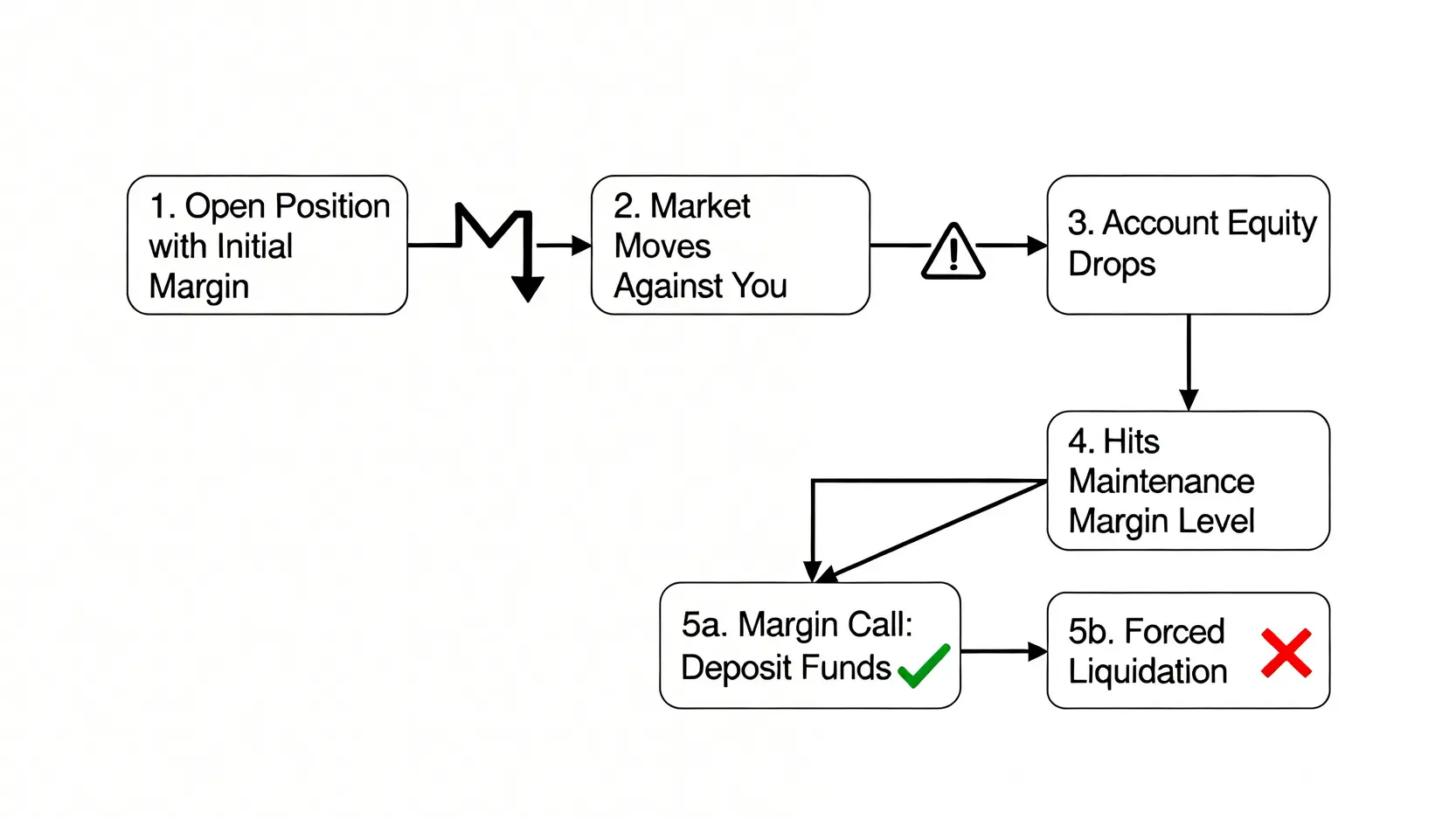
  2. Maintenance margin: After you hold a position, if market movements turn unfavorable and your margin level falls to this threshold, the broker will issue a “margin call”, requiring you to deposit additional funds to restore it to the initial margin level, otherwise forced liquidation will occur.

Since large contracts have a higher contract value and greater risk, their margin requirements are significantly higher than those of mini contracts. The following is a reference example (please note that margin amounts may be adjusted by the Hong Kong Exchanges and Clearing Limited based on market conditions. Always check the latest requirements before trading):

Contract Type Initial Margin (Reference) Maintenance Margin (Reference)
Large Contracts (HSI) ~ HK$80,000 – HK$120,000 ~ HK$64,000 – HK$96,000
Mini Contracts (MHI) ~ HK$16,000 – HK$24,000

~ HK$12,800 – HK$19,200


[Mini Hang Seng Entry Cost Calculation] Trading Cost Comparison, How Should Beginners Choose?

The true “Mini Hang Seng entry cost” does not refer to margin alone. A complete trading cost should also include broker commissions and other miscellaneous fees. A more prudent capital preparation strategy is:

Actual entry cost = initial margin + trading costs (round-trip commissions, exchange fees, etc.) + additional buffer funds

It is strongly recommended to prepare at least an additional 30-50% of funds beyond the margin as a buffer to cope with market fluctuations, avoiding being forced to add margin or undergo forced liquidation due to minor losses. For example, if the initial margin for Mini Hang Seng is HK$20,000, a relatively safe starting capital would be HK$26,000 – HK$30,000.

Beginner selection advice:
Without a doubt, for beginners or investors with smaller capital, starting with “Mini contracts” (Mini Hang Seng Index futures) is the only reasonable choice. It has a lower threshold and relatively controllable risk, allowing you to learn how the market operates and test your trading strategies at a lower cost. Once you have accumulated sufficient experience and capital, you can then consider switching to large contracts. 

Understanding “Hang Seng Index Futures Leverage”: A Wealth Amplifier or a Risk Beast?

Leverage is the most fascinating and most dangerous feature of futures trading. It allows you to “do ten units of work with one unit of capital”, but losses will also erode your principal at the same multiple. Understanding how Hang Seng Index futures leverage works is the first step in risk management.


Leverage Principle: How to Control Large Contracts With Small Capital?

The formula for calculating leverage is very simple:

Leverage ratio = total contract value / initial margin

Where total contract value = current index level * contract multiplier.

Assume the Hang Seng Index is at 18,000 points, and the initial margins for large and mini contracts are HK$100,000 and HK$20,000 respectively:

  • Large contract value = 18,000 * HK$50 = HK$900,000
    Large contract leverage ≈ HK$900,000 / HK$100,000 = 9 times
  • Mini contract value = 18,000 * HK$10 = HK$180,000
    Mini contract leverage ≈ HK$180,000 / HK$20,000 = 9 times

From the calculation, it can be seen that under official margin requirements, the leverage ratios of large and mini contracts are theoretically similar. This means that every 1 unit of margin you invest actually controls assets worth 9 units. Your return rate and loss rate will both be amplified 9 times.


Leverage Risk Calculation and Margin Call Mechanism

The core of leverage risk lies in “forced liquidation”. When your losses erode your margin below the “maintenance margin” level, a Margin Call will be triggered.

恆指期貨保證金追繳流程圖,解釋了從開倉到虧損觸及維持保證金,再到面臨補倉或強制平倉的完整過程。

Futures Margin Call Process Illustration

Scenario simulation:
Assume you use HK$20,000 initial margin to go long on a mini contract when the index is at 18,000 points, and the maintenance margin is HK$16,000.

  • Your risk buffer = $20,000 – $16,000 = $4,000
  • Each point of the mini contract is worth HK$10, which means the index can fall at most: $4,000 / $10 per point = 400 points.
  • Once the index falls from 18,000 to 17,600 points (18,000 – 400), your margin will reach the maintenance level.
  • At this point, the broker will require you to add funds back to the initial level of HK$20,000. If you fail to do so in time, the broker has the right to forcibly sell your position and realize the loss.

This is why futures trading should never be conducted with “full capital deployment” and sufficient additional funds must be reserved in the account to withstand normal market fluctuations. If you want to further understand futures trading basics, you can refer to a more comprehensive guide. 

Further Reading (Highly Recommended)

Futures Technical Analysis Beginner Guide: Master Trend Identification and Common Indicators from 0 to 1

Taiwan Index Futures Margin Ultimate Guide: Query, Calculation, and Risk Management in One Article!


Frequently Asked Questions About Hang Seng Index Futures Trading (FAQ)

Q: How is the settlement date of Hang Seng Index futures calculated?

A: The final settlement date of Hang Seng Index futures is the second last trading day of the contract month. For example, for a June futures contract, the settlement date is the second last business day of June. On that day, the index is settled at a “final settlement price”, and all open positions will be automatically closed at this price.

Q: What are the trading hours of index futures? Is there a night session (T+1 session)?

A: Yes, Hang Seng Index futures have both daytime and nighttime trading sessions. The daytime trading session (T session) is generally in sync with the Hong Kong stock market, from 9:15 AM to 12:00 PM, and from 1:00 PM to 4:30 PM. After market close, there is also a T+1 session, commonly known as the “night session”, which runs from 5:15 PM to 3:00 AM the next day. Price movements during the night session are influenced by US and European markets.

Q: Besides margin, are there other costs when trading Hang Seng Index futures?

A: Yes. In addition to margin as a “deposit”, actual trading costs also include:

  1. Broker commissions: Charged when buying and selling.
    2. Exchange fees: Charged by the Hong Kong Exchanges and Clearing Limited, calculated per contract.
    3. SFC levy: Charged by the Securities and Futures Commission.
    4. Investor Compensation Fund levy (if applicable)
    Although these costs are not high per trade, they can accumulate into a significant expense for short-term traders who trade frequently.


Conclusion

In summary, regardless of whether you choose large or mini contracts, fully understanding their margin requirements and the leverage risks of Hang Seng Index futures is the first step to success. The main differences between large and mini contracts lie in capital threshold and risk level, while the leverage ratio depends on the proportion of margin you invest relative to the contract value. For beginners, starting with Mini Hang Seng Index futures, which have a lower entry threshold and more manageable risk, is undoubtedly the more prudent choice. By accumulating practical experience through mini contracts and learning capital management and risk control, you will progress toward becoming a mature futures trader. This article aims to help you build a clear knowledge framework and lay a solid foundation for your futures investment journey.

If you liked this article, please share it!

Related Articles

  • Volatility Surface Guide: Skew Trading Strategies
    Practical Applications of Volatility Surfaces: From Options Modeling to Advanced Skew Trading Strategies In options markets, implied volatility is never a flat line. Instead, it forms complex "smile" or "skew" surfaces. For advanced traders, mastering the practical applications of volatility surfaces is equivalent to possessing a lens that reveals market...
    2026 年 6 月 3 日
  • Foreign Capital Flow Model: Track Institutional Money
    Building a Foreign Capital Flow Copy Trading Model: A Stock Market Indicator for Accurately Tracking Institutional Positioning In Asia-Pacific stock markets, foreign capital inflows and outflows often determine the direction of the index. However, simply looking at daily net buy and sell data is no longer enough. Only by building...
    2026 年 6 月 3 日
  • Options Buying Strategies for Extreme Market Risks
    Options Buyer Strategies During Extreme Market Conditions: Black Swan Hedging and Cross-Market Arbitrage During Volatility Surges The most terrifying aspect of financial markets is not a gradual decline, but overnight flash crashes and cross-market capital withdrawals accompanied by volatility surges. In the highly unpredictable global macroeconomic environment of 2026, geopolitical...
    2026 年 6 月 3 日
返回顶部