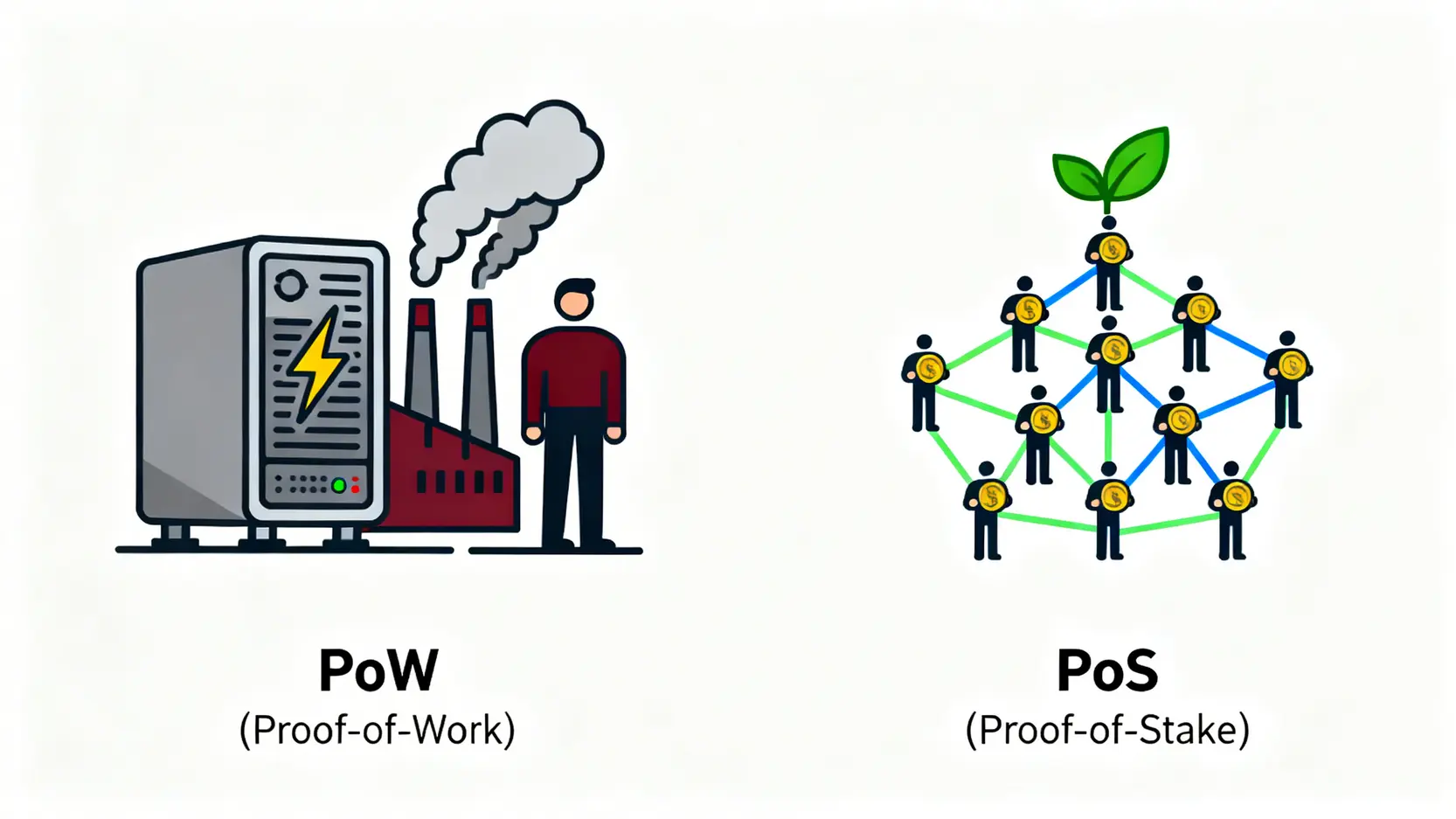
PoW vs PoS: The PoS mechanism used by Cardano offers advantages in sustainability and decentralization.
- Energy Efficiency: Staking ADA requires far less energy than mining because it does not rely on large scale computational power. This makes it a greener and more sustainable blockchain system.
- Low Entry Barrier: Anyone who holds ADA can delegate their tokens to a stake pool and participate in network validation. No expensive mining equipment is required.
- Greater Decentralization: Proof of Stake encourages broader participation in network validation, helping prevent power concentration among a few large mining pools and improving network security.
The Ouroboros Protocol: The Foundation of Cardano Security
Cardano’s Proof of Stake system is powered by the “Ouroboros” protocol. Ouroboros is the first PoS protocol that has been academically peer reviewed and mathematically proven to be secure. The system divides time into “epochs”, each consisting of multiple “slots”. For every slot, the protocol randomly selects a leader (typically a stake pool), responsible for creating the next block.
This design ensures fairness and randomness in block production while providing mathematically verifiable security against potential attacks. Thanks to Ouroboros, ADA holders can confidently participate in staking while helping secure the network.
ADA Staking Rewards Analysis: Why You Should Stake ADA?
After understanding the technical foundation of Cardano staking, the next question is practical. What benefits does staking ADA offer?
Expected Annual Yield (APY): How Much Passive Income Can You Earn
The most direct benefit of staking ADA is passive income. Cardano’s staking yield typically ranges between 3 percent and 5 percent annually. The exact return depends on factors such as the total amount of ADA staked across the network and the performance of the selected stake pool.
This means that in addition to potential price appreciation, your ADA holdings can gradually “generate” additional ADA over time. This is a typical “asset activation” strategy. Compared with leaving your assets idle in a wallet or exchange, staking is undoubtedly a wiser choice.
Liquidity Advantage: No Lockup Period for ADA Staking
One of the major advantages of Cardano staking is flexibility. Many other Proof of Stake blockchains require assets to be locked for a certain period when staking. Cardano uses a “liquid” staking model.
When you delegate ADA to a stake pool, your tokens remain in your personal wallet and you maintain full control over them. You can spend, transfer, or sell them at any time without waiting for an unlocking period. This flexibility allows investors to earn staking rewards while remaining responsive to market changes.
Supporting Network Security and Ecosystem Growth
Every ADA delegation contributes to the decentralization and security of the Cardano network. The more ADA distributed among different stake pools, the more secure and resilient the network becomes against attacks. Staking therefore benefits both the individual investor and the ecosystem as a whole. For long term supporters of Cardano, staking represents both participation and contribution.
ADA Staking Tutorial: Five Simple Steps
Now let’s move from theory to practice. Follow these five steps to start staking ADA and generating passive income.
Step 1: Choose a Secure Cardano Wallet
First, you need a wallet that supports Cardano staking. It is generally recommended to stake from your own wallet rather than directly through centralized exchanges so you maintain full control of your assets. Common options include:
- Yoroi Wallet: A lightweight official wallet available as a browser extension and mobile app. It does not require downloading the entire blockchain, making it fast and beginner friendly.
- Daedalus Wallet: The official full node desktop wallet. It downloads and synchronizes the entire Cardano blockchain, providing maximum decentralization and security but requiring more storage and time.
- Hardware Wallet (such as Ledger / Trezor): This is the gold standard of security. You can pair a hardware wallet with Yoroi or Daedalus, ensuring the private key never touches the internet, thereby maximizing the protection of your assets. It is strongly recommended for investors holding large amounts of assets. To learn more, you can refer to this Ultimate Guide to Bitcoin Cold Wallets in Hong Kong 2026: Selected Recommendations and Secure Usage Tutorial.
Step Two: Purchase or Transfer ADA Into Your Wallet
After choosing and setting up your wallet, you need to deposit ADA into it. You can purchase ADA from any major cryptocurrency exchange (such as Binance, Coinbase, etc.), then withdraw it to the wallet address you have just created.
Step Three: How to Evaluate and Choose a High Quality Stake Pool
This is the most critical step in the entire staking process, because the performance of the stake pool directly affects your ADA Staking returns. In the “Delegation” interface of the wallet, you will see a list of stake pools. When evaluating them, you should pay attention to the following indicators:
| Evaluation Indicators |
Description
|
| Real Time Return on Assets (ROA) |
Displays the pool’s recent annualized return rate, which can serve as a reference but does not represent future returns. |
| Saturation |
When a pool’s staked amount approaches the saturation point, its rewards will begin to decline. Avoid choosing pools that are close to or exceed 100% saturation. |
| Fees |
Includes a fixed fee (minimum 340 ADA) and a variable fee (margin). The lower the fees, the more rewards are distributed to delegators. |
| Pledge |
The amount of ADA that the pool operator has committed. A higher pledge usually indicates greater commitment and confidence from the operator. |
| Block Production Record |
Review the pool’s historical block production stability. A pool that has consistently produced blocks over the long term is generally more reliable. |
You can use third party tools such as PoolTool.io and CardanoScan to conduct deeper research and comparisons.
Step Four: Start Delegating Your ADA for Staking
After selecting your preferred stake pool, click the “Delegate” button in your wallet, enter the pool ID or name of the pool you selected, and then confirm the transaction according to the instructions. This transaction will incur a small network fee (approximately 0.17 ADA) and a deposit of 2 ADA (this deposit can be refunded when you stop staking in the future).
Step Five: How to Track and Receive Your Staking Rewards
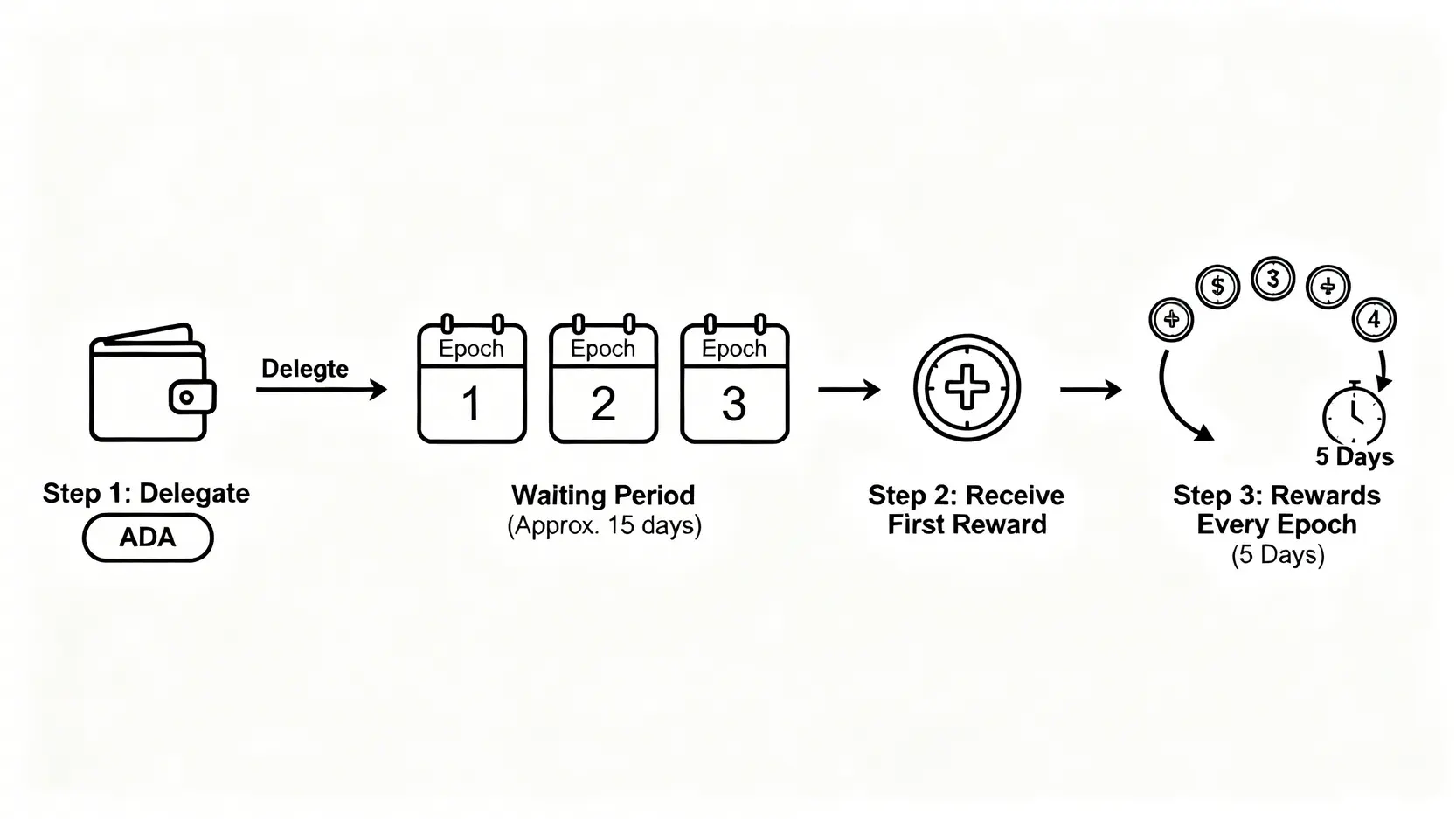
After a successful delegation, you will need some patience. The Cardano network operates in units called “Epochs”, with each epoch lasting 5 days. The activation of your staking and the reward distribution cycle are as follows: